I am ingesting 847 tables across 12 databases into one corporate data warehouse.
A year ago, this was a quarter of someone’s life. A team of analysts. A wall of spreadsheets tracking source columns against target columns. Hand-written .sql mapping files, one per source system, each one a small act of archaeology. A planning cycle you measured in quarters, not weeks, because nobody could hold the whole shape of it in their head at once.
Not anymore. AI scoped the proof of concept at two weeks. It was done in hours. One person, one harness, one warehouse on the far end.
And the person doing it is me. A director who sets the direction and executes it.
Collapsing the Timeline
Here is what actually happened. I pointed AI at the source schemas and it read them. All of them. It surfaced the mappings, the obvious joins, the foreign keys, and then it surfaced the gaps: the columns that did not line up, the types that would not cast cleanly, the orphaned tables nobody documented. Then it drafted the migration plan. In hours.
I did not take that plan on faith. I read it, rejected the joins that were wrong, and made it defend the casts I did not trust. AI did not remove the judgment. It removed the months of mechanical work that used to bury it.
It scoped the full production migration too, the real build on top of that proof of concept, at twelve weeks. A year ago, the analysis and mapping alone, just deciding how, would have burned a quarter before anyone wrote a line of production code.
The thing that used to take up months of work was the distance between knowing what we wanted and knowing how to get there. That distance is now near-zero.
The intent was always clear. We want the data from these 847 tables in one place. The execution was the expensive part. The mapping, the planning, the sequencing, the careful inventory of everything that could break. AI collapsed the execution distance to almost nothing. Strategic intent and execution used to sit on opposite ends of a long, slow bridge. AI did not make that bridge faster to cross. It folded the two ends together until there was no crossing left to make. Call it the Einstein-Rosen bridge of technical work: not a quicker route between two distant points, but a fold in space-time that drops them in the same place. The distance did not shrink. It stopped existing.
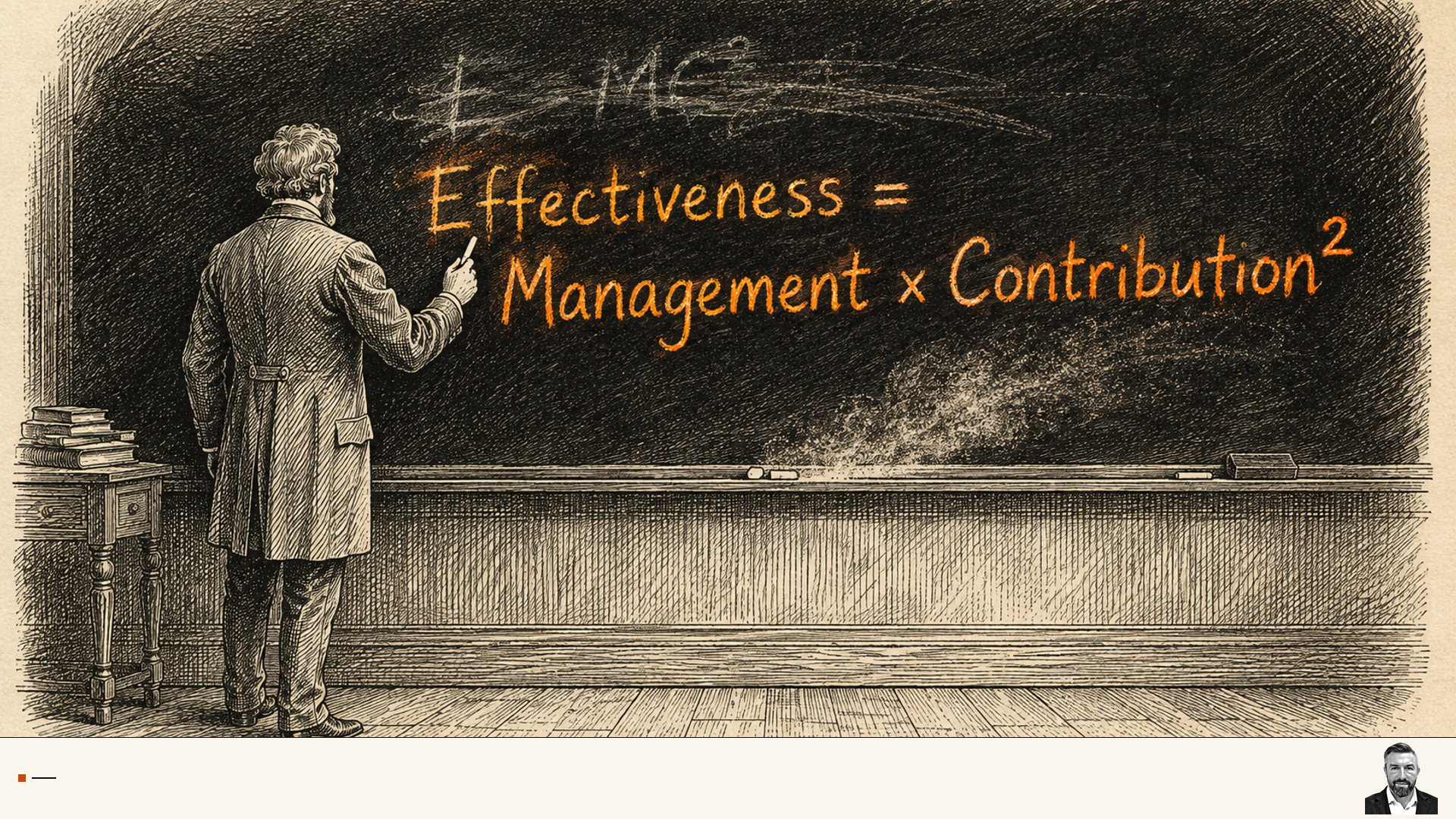
E = MC²
E = MC². Energy equals mass times the speed of light squared. The famous part is the exponent. A small amount of mass, multiplied by an enormous squared constant, releases an absurd amount of energy. The leverage lives in the square.
Here is the version that runs an engineering org now:
Effectiveness = Management × Contribution²
M is the management mode: aim, strategy, direction, choosing the target. C is the contribution mode: execution, the act of building, the capability to actually move the thing. These are not headcounts. They are modes of work. A single person can operate in both.
M is linear. More aim is good, but it scales linearly. Double it and you double the output, no more. The exponent lives on C. Contribution is the squared term. And AI just multiplied what a single unit of contribution can do.
That is the whole insight. The variable AI supercharged is the one with the exponent on it.
Mass Into Energy
So when a director picks up a keyboard and starts building, that is not a step down. That is not a director slumming it in the weeds because the calendar got quiet.
It is crossing into the exponential term.
I did not plan out hundreds of dim and fact tables or migrate the data from 847 OLTP tables to prove I still have it. I did it because contribution is where the square is, and I now have the tooling to operate there at a level that used to require a team. A director can drop into a major initiative and personally move it. Not sponsor it. Not unblock it in a status meeting. Move it. Ship the thing.
Every instinct trained into us says this is a mistake. A director in the code is a hero pattern, a leader who cannot delegate. That instinct was right when contributing meant a director hunched over a keyboard for a person-quarter, pulled off everything else the role demands. This is not that. I am not the one typing. The keyboard work is delegated to AI, which runs asynchronously while I keep doing the rest of my job. Think of it as another employee, one that channels the executive’s mass: the knowledge, the judgment, the sense of which target actually matters. This is not hands-on in the old sense at all. It is delegation, pointed at a contributor that happens to work at machine speed.
The reason to cross over is mathematical, not motivational. It is not about staying technical or staying humble or any of the usual stories we tell about leaders who still code. It is that contribution carries the exponent, AI just made the exponent enormous, and staying entirely in the linear term while that happens is leaving leverage on the floor.
And here is what the equation says that the org chart does not: the more management mass you carry, the more energy you release when you convert it. A junior engineer crossing into contribution releases a junior engineer’s worth of output. When a director crosses in, the mass being converted is years of context, judgment, and hard-won pattern recognition about what actually matters. Same exponent, far more mass. A director contributing this way is not a vanity. It is the highest-energy reaction available to the org.
Lead Into Gold
The data warehouse is one example. Here is another, from the opposite end of the work.
Technical debt. The architectural rework that everyone agrees needs to happen and nobody schedules. The kind of change that used to demand a quarter of planning and a migration committee and a risk review and three teams agreeing on a cutover window. The kind of change that dies in the gap between intent and execution, every time, because the execution cost is brutal.
AI can identify and action fundamental rework now, including architecture-level change, on a time horizon that used to be impossible. It reads the system, finds the load-bearing decisions, maps the blast radius, and drafts the path through. The quarter of planning compresses the same way the 847 tables did.
This is the closest thing engineering has to transmutation. The alchemists chased a way to turn lead into gold and never found it. We turn a decade of accumulated debt into an architecture we would choose on purpose, and we do it in an afternoon.
Same collapse. Different domain. The distance between “we should fix this” and “it is fixed” is measured in moments, not months.
Critical Mass
Here is the part that keeps this from being a fantasy about directors typing their way to glory.
The exponent only helps if the aim is right.
C is squared, which means whatever C is pointed at gets squared too. Point it at the wrong initiative and you do not get a small mistake. You get the mistake squared. A director flooding into the wrong project does not just waste a director’s time. They square the waste, because the waste is now riding the exponent too.
That is why M is still scarce. Choosing which initiative deserves you, choosing the target, deciding that the data warehouse matters more this quarter than the other six things screaming for attention: that is the manager’s real job, and AI did not touch it. AI made hitting the target cheap. It did not tell you which target.
The aim is the bottleneck now. It was always the bottleneck. We just could not see it before, because execution was so expensive that bad aim got caught and corrected on the long, slow walk across the bridge. The bridge bought us time to notice we were wrong. The bridge is gone. Bad aim now ships at full speed.
Aim it right, though, and the same exponent that amplifies waste amplifies everyone. Crossing into C is not a story about managers replacing the people who already live there. The warehouse I am building does not take work away from my data analysts. It hands them a foundation they never had, so they can write sharper reports and surface data to leadership faster than ever before. A leader who crosses in and aims well does not shrink the team’s world. They enlarge it. The exponent lifts everyone standing on the result.
Escape Velocity
The gap between intent and execution is collapsing across the whole org. Not just in data migrations. Not just in technical debt. Everywhere there used to be a long, expensive walk from a decision to a result.
The leaders who compound in this environment are the ones willing to cross into the exponent and personally move the work, and then willing to climb back out and aim again. Build, then choose. Square the contribution, then reset the target. Down into C, back up into M, and down again.
Pick the right mountain. Then go move it yourself.
Receipts
- Data warehouse proof of concept: I used AI to inspect and map 847 tables across 12 databases. A proof of concept initially scoped at two weeks was completed in hours, with human review correcting joins and casts before the plan was trusted.
- Production scope: The resulting production migration was scoped at twelve weeks. Before AI-assisted analysis, the discovery and mapping work alone would have consumed roughly a quarter.
- Constraint that remains: AI reduced the mechanical distance between an objective and an executable plan. It did not choose the right initiative, validate the business priority, or replace the director’s judgment about whether this warehouse mattered more than competing work.