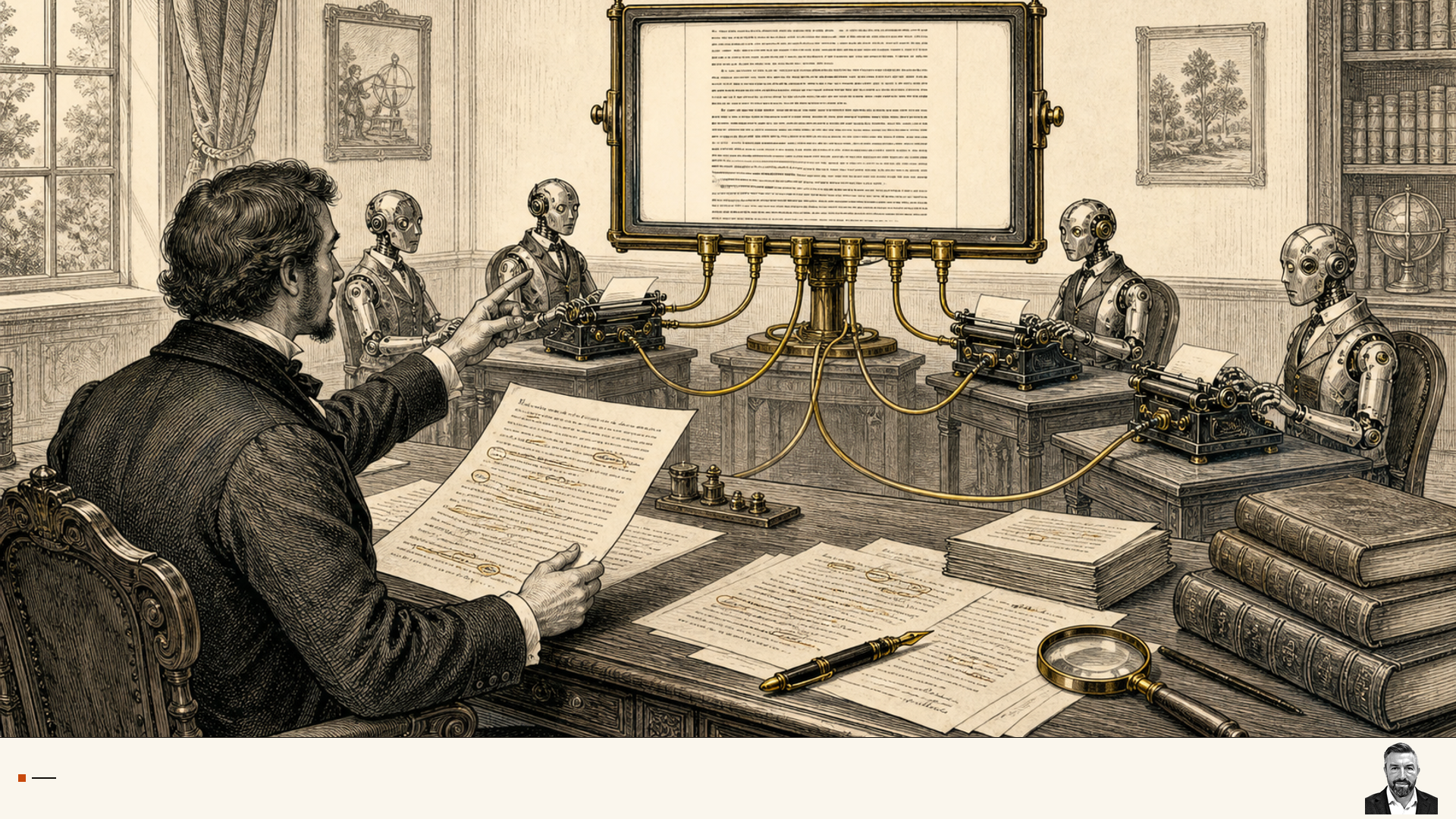
I use AI to help write this blog. That should not be controversial. It probably is.
There is a real, meaningful difference between using AI as part of a writing process and asking a model to generate an article, glancing at it, and publishing the result. The first resembles spec-driven development with a human in the loop. The second is vibe-writing: a one-shot attempt to turn a rough idea into finished work without doing the work or accepting the responsibility.
I am willing to defend the first process. I have no interest in defending the second.
The Work Still Has To Start With You
Most of the posts on this site begin with an observation from work, a decision I made, an idea I have been developing, or a story that keeps resurfacing because it taught me something useful. AI does not supply those things. It cannot have lived through the failed migrations, the production outages, the difficult personnel decisions, or the rebuilds that took months to win approval for.
It can, however, help me develop the idea. I may start with a rough thought, then use a conversation to test whether the argument holds together. The AI can identify missing premises, offer a counterargument, suggest places where a reader will want evidence, or point out that two ideas I thought belonged together should be separate essays. It can search for relevant research and help distinguish a durable principle from a timely assertion that needs a date and a source.
All of those are editorial functions. Good human editors perform them too. They ask what you mean, what you are assuming, where the reader will push back, and whether the evidence supports the line you want to write. AI speeds this process, costs far less than bringing in an editor for every early pass, and can draw on a broad working knowledge of writing and rhetorical techniques.
I still decide if the argument is worth making. I decide which evidence matters, which examples can be responsibly shared, and which conclusion is actually true. That is the same responsibility I carry when I review an AI-generated pull request. The agent may have written the implementation. I still determine whether it belongs in the system, satisfies the standards, and is safe to ship.
The Draft Is a Work Product
Once I have an idea for an essay, AI is useful for the part I find difficult: getting a complete first version onto the page. It can organize a set of rough notes, identify possible structures, develop transitions, and turn a short statement into a paragraph that can be examined.
That matters because reacting to a draft is easier than spewing words onto a blank page. I struggle with self-editing with every sentence I type. I re-think every sentence as I write it and it takes forever to get a piece written. (It’s even worse when I’m working on paper!) I give my developers the same advice when they are working through an ambiguous problem: bring something concrete to react against. A rough design, a sample payload, or a first-pass implementation gives the team something to test, challenge, and improve. A draft plays the same role for writing. I can see where the logic is weak, where an anecdote needs more context, where a line has drifted away from my actual belief, or where the writing has become more polished than honest.
The draft gives me something concrete to argue with. That is how many posts here are built. I introduce the premise and the lived evidence. AI offers structure and language. I correct the history, change the framing, reject unsupported assertions, add the details that make an anecdote true, and remove material that does not belong. Sometimes this results in a whole new section. Sometimes an elegant paragraph gets binned because it doesn’t truly support the essay.
The process is recursive. The essay gets better because it is challenged, revised, and challenged again. Tony Wan describes a similar practice as “vibe writing”: rounds of dialogue that turn rough ideas and prose into more coherent work while the writer retains agency. His strongest advice is also the right standard: put as much of the real thinking as possible on the page before asking for help, then disagree with the model often enough to keep the work yours. How I Learned to Stop Worrying and Love Vibe Writing
I use the term more narrowly. A conversation and a revision loop can produce a piece I am willing to put my name behind. A single prompt followed by hitting the publish button is vibe-writing in the pejorative sense.
A Good Editor Creates Friction
The useful version of AI assistance does not merely make prose smoother. It creates productive resistance. When I am developing a post, I want the AI to ask for a concrete example that grounds an idea instead of letting me pontificate without receipts. I want it to find the contrary evidence when I am making a prediction. I want it to flag a metaphor that has become decorative rather than explanatory. I want it to identify a missing business constraint in a technical story.
That friction protects the reader from a polished but hollow argument. It also protects me from writing the version of a story that makes me look best rather than the version that teaches the clearest lesson. It keeps the essays honest, grounded in reality, and, dare I say, humble.
I use AI differently while writing a fiction novel. I type every word myself because the novel’s tone is central and particular, and I want direct control over every sentence that carries it. I do not believe current models can maintain that voice with the accuracy I desire.
Nonfiction involves a different tradeoff. Voice matters here too, but the practical, direct tone I use on this blog is more consistent and easier to capture in a personalized style guide. AI can help produce a first draft without replacing the editorial decisions that make the work mine.
For the novel, I use AI as an editor. It reviews pages regularly against the canon I have already established: continuity, tone, character behavior, and the details that must remain true as the story grows. I maintain a local canon-control system with a canon index, character profiles, story reference material, system rules, and structured review findings. The tool can analyze a selected manuscript section against those documents and flag a likely conflict, an ambiguity, or a continuity question. It never modifies the master manuscript.
That availability has helped me find my way out of writing jams. The AI can point out a constraint I forgot, show where a character’s reaction has drifted, or help me see a route through a scene that I could not find on my own. A human editor might make those checks chapter by chapter or across an entire manuscript. I can ask for the same kind of review whenever I need it. The words and the final creative choices remain mine.
A recent chapter review checked whether new character behavior fit established canon, identified a new healing rule that needed to be formalized in the story bible, caught line-level errors, and suggested a subtle surveillance beat to strengthen the scene. It did not rewrite the chapter or decide which changes to accept. It gave me the same kind of specific, on-demand editorial pressure I would want from a human editor.
The process resembles code review. A good reviewer does not simply correct formatting and approve the pull request. The reviewer asks whether the change belongs there, whether it handles the real failure mode, whether the test proves what the writer thinks it proves, and what happens when the next developer has to maintain it. An editorial partner earns its place by creating the same kind of pressure.
The Audit Supports Judgment
Before a post goes out, I run a content-voice audit against it. The audit checks for patterns that make AI-assisted writing feel generic or synthetic: em dashes, repeated contrast formulas, excessive one-line paragraphs, mechanical lists of three, and assertions that sound certain without evidence. (You’ll notice this list has 5 items!)
The audit has been useful because it catches patterns that are hard to see inside a draft you have read ten times. It helps separate a piece with intentional, punchy lines from a page that reads like a LinkedIn carousel. It shows where a metaphor is doing useful work and where a conclusion merely restates the heading in a cleaner font.
The audit cannot decide whether an argument is important, whether an anecdote is fair, or whether the final voice sounds like me. It surfaces places worth inspecting. I make the editorial call.
That is the same role I expect automated checks to play in software. A linter, a test suite, and a code scorecard can make quality visible. They cannot own the architecture, the tradeoffs, or the decision to ship.
Evidence Has To Survive Contact With Reality
AI serves as a super-efficient research assistant. It can scan a broad body of material, surface sources I might have missed, summarize competing positions, and point me toward the evidence I need to understand a topic before writing about it. That speed requires a verification step. A clean citation can be wrong, incomplete, or attached to an assertion the source does not actually make.
Every external factual assertion in a post needs to be checked against the source. Predictions need to be marked as predictions. First-hand observations need to be identified as first-hand observations. When a post relies on evidence, I include a Receipts section so readers can inspect the material that informed the argument.
A public blog has a different standard from a peer-reviewed journal. It is a public record of how I think about software, leadership, and AI. The standard is still simple: I should be able to explain and defend every meaningful assertion carrying my name.
Elsevier’s policy for AI-assisted writing states the principle cleanly. It permits responsible use, requires human oversight and verification, and leaves the human author responsible for the accuracy and integrity of the work. The disclosure requirements belong to its publishing environment. The accountability principle belongs everywhere.
My Name Means I Am Responsible
Putting your name on a piece has never required performing every mechanical step yourself. Writers use grad students, editors, researchers, copyeditors, fact checkers, dictionaries, style manuals, and software. A photographer still composes the image while the camera handles exposure, a lab technician handles development, and another technician handles printing. A conductor still leads the performance while every musician plays an instrument the conductor cannot operate.
Academic work rarely comes from one pair of hands. Graduate students may conduct research, analyze results, and draft sections. Everyone who makes a substantial intellectual contribution deserves credit. The senior researcher who puts their name behind the work still directs it, reviews it, approves publication, and takes responsibility for the whole.
AI changes the speed and scope of assistance, especially for an individual. Direction and responsibility remain human work.
The real test is straightforward. Can I explain the premise? Can I defend the evidence? Can I identify the tradeoffs I chose? Can I recognize a sentence that says something I do not believe? Can I revise the work when a reader shows me that I was wrong?
Can you?
If the answer is yes, AI assistance can make you a more capable writer. It can help you research more broadly, develop ideas more carefully, and revise more rigorously.
If you cannot explain the premise, defend the evidence, or revise the piece when someone finds a problem, it is not ready to publish, under your name or anyone else’s.
Receipts
- Practitioner precedent: Tony Wan describes AI-assisted writing as an iterative editorial dialogue, while emphasizing that the writer must retain agency, reject weak suggestions, and verify sources. How I Learned to Stop Worrying and Love Vibe Writing
- Accountability standard: Elsevier permits responsible AI assistance in writing, but requires human oversight, source verification, original author contribution, disclosure in its publishing context, and author accountability for the final work. Generative AI policies
- Academic precedent: ICMJE guidance requires that people who meet its contribution threshold have the opportunity to participate in review, drafting, and final approval. It also requires all listed authors to be able to take public responsibility for the work. Defining the Role of Authors and Contributors
- First-party process: This blog’s posts are developed through writer-led conversations, source review, iterative drafting, manual editorial decisions, a personalized style guide, a content-voice audit, and final approval. AI assistance may shape individual passages, but I am responsible for every published assertion.
- Fiction editorial workflow: While drafting a fiction novel, I write every word myself and use a local canon-control system for on-demand AI review. Its canonical references, structured findings, and read-only treatment of the master manuscript make continuity, tone, character behavior, and story constraints inspectable without allowing automatic edits. The review helps identify writing jams, but the words and creative choices remain mine.