Every engineering team I’ve worked with has the same legacy code conversation.
“We need to modernize the codebase.” Everyone agrees. “It’s going to take forever and we’ll probably break something critical.” Everyone also agrees. So the project gets scoped, added to the roadmap, deprioritized for more urgent work, and pushed to next quarter. And next quarter. And the quarter after that.
The problem isn’t willingness. It isn’t even time, though that’s what everyone blames. The real problem is risk. Specifically, one category of risk that makes legacy modernization genuinely dangerous: the business rules buried in the code.
The Real Cost of Legacy Modernization
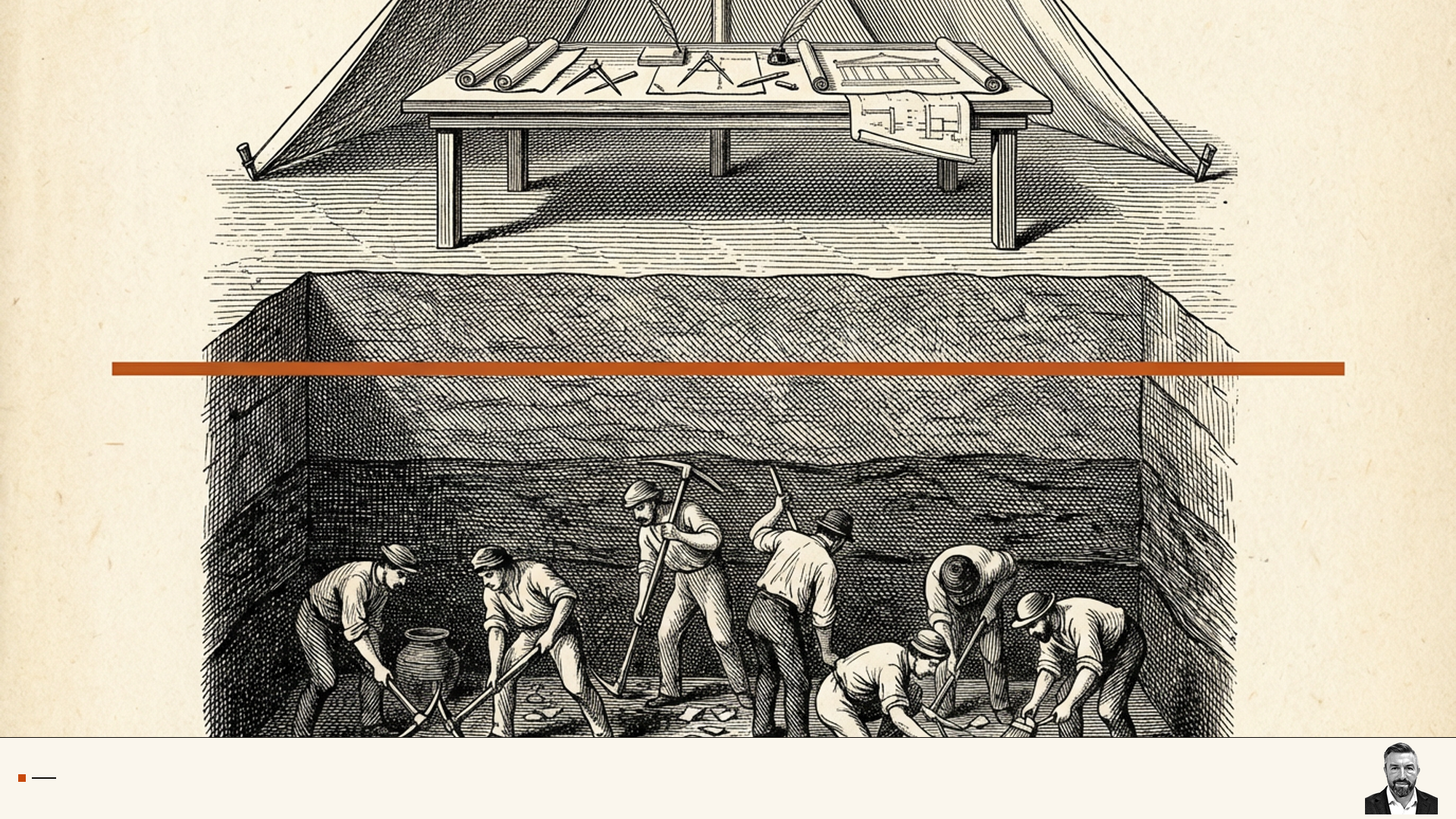
Old code is dense with knowledge. Some of it is architectural (how the system is structured). Some of it is technical (what database schema it expects, what APIs it calls). But a significant portion is business logic that was never documented anywhere else. Rounding rules that match a contract from 2009. Edge case handling for a specific client’s workflow. Validation rules that reflect a regulatory requirement nobody remembers. Tax calculation logic that a developer reverse-engineered from a spreadsheet twelve years ago.
When you modernize by rewriting, this is what you’re most likely to lose. Not because your developers are careless. Because the knowledge is scattered across thousands of lines of code, embedded in method names that made sense to someone in 2011, commented out in blocks nobody has touched in years. There’s no document that says “here are all the business rules.” There’s just the code.
The first time I ran a form of this pipeline was against the point-of-sale application our sales reps use at my current company. The application is old, dated, and slow. The agent I used at the time was sufficient, but not exceptional. It found useful behavior. It also missed things. We later identified gaps in the analysis, and the review surfaced places where old logic had been left behind even though it was effectively dark or dead.
That experience shaped the process. The extraction document is not magic truth. It is a working artifact that needs review, comparison against known behavior, and validation by people who understand the business.
The traditional options are both bad. Do a big-bang rewrite and risk losing critical rules in the transition. Do incremental refactoring and watch the project stall because there’s always something more urgent.
There’s a third option. And it requires rethinking who (or what) does the extraction work.
The Three-Agent Pipeline
The approach is a sequential pipeline with three specialized AI agents, each handling a distinct phase of the modernization. The key insight is that the work has to happen in order: document before you design, design before you build.
Agent 1: The Business Analyst
The first agent’s job is to read the existing codebase as a business analyst, not as a developer. It’s not looking for how the code works. It’s looking for what the code knows.
This is not the place to use the cheapest or fastest model available. The BA step is where the pipeline is most vulnerable to missed context, subtle business rules, and false confidence. Use the strongest reasoning model you have access to, and set the thinking effort high. If you have access to models in the GPT-5.5 or Opus 4.8 class, this is the kind of work where they earn their keep.
This is true of most serious AI work. The more effort you spend up front on the process, the better the output gets. Cheap extraction creates expensive correction later.
This means scanning for:
- Business rules: Conditional logic that reflects domain decisions (“if the account type is X and the balance exceeds Y…”), validation rules, calculation logic, edge case handling
- Domain vocabulary: What entities exist, what they’re called, what relationships the system models
- Integration contracts: What external systems the code talks to, what data it sends and receives, what assumptions it makes about those interactions
- Implicit policies: Behaviors that are enforced by the code but never documented anywhere (rate limits, access rules, data retention patterns)
The output is structured documentation that captures this knowledge in a system of record. For most teams, that’s Confluence. It could be any documentation platform. The point is that the business rules are now outside the code, in human-readable form, reviewable by stakeholders who can verify the accuracy of what was extracted.
This step alone is valuable regardless of what comes next. In our own use, it has surfaced dead paths, dark logic, and behaviors that were no longer obvious to the current team. That matters because modernization is not only about preserving what works. It is also about discovering which inherited behaviors still deserve to exist.
We have since refined the process and run it across multiple applications. It has been especially useful for a suite of console applications that we are migrating into lambdas or container apps that can spin up on demand. Those applications are small enough to translate in controlled increments, but old enough that the behavior still needs to be extracted before anything is rebuilt.
Agent 2: The Product Owner
The second agent takes the BA’s documentation and turns it into structured work items.
This is where the pipeline connects to the requirements workflow I’ve written about separately (the feature-writer to story-splitter to story-writer to prefinement chain). The PO agent reads the extracted business documentation and creates features and stories that represent the modernized implementation.
Each story captures:
- What the modernized system needs to do (derived from the extracted business rule)
- Acceptance criteria that can be verified against the original behavior
- The context needed for a developer (or developer agent) to implement it correctly
The work items live in your existing tracking system (Jira, Azure DevOps, or wherever your team works). They’re linked to the source documentation. They follow the same quality standards as any other story your team would produce.
This step transforms raw extracted knowledge into an executable plan. The modernization isn’t a vague directive anymore. It’s a backlog of well-scoped, well-defined stories that any developer on the team can pick up.
Agent 3: The Developer
The third agent reads the work items and implements them according to your current architecture and coding standards.
This agent operates the same way any AI developer agent would in your environment: loading your CLAUDE.md, following your architecture standards, using the patterns established in your modern codebase. The difference is the input. Instead of a vague feature request or a verbal description, it has a precisely written story with acceptance criteria derived directly from the legacy system’s behavior.
The output is modern code that does what the legacy system does, written to your current standards, with no direct dependency on how the original was implemented. It’s not a line-by-line translation. It’s a reimplementation from specification.
Since I first wrote about this pattern, multi-agent development has become more common. The developer step does not have to be one agent doing everything. One viable version uses one agent to implement the code, another to write or expand the tests, another to review the functional behavior, and another to oversee the work and coordinate the sequence.
That does not change the pipeline. It changes the execution model inside the third stage. The important point is that all of those agents are working from the extracted documentation, the modern stories, and the current engineering standards. They are not independently rummaging through the legacy code and reintroducing old patterns by accident.
That specification can be wrong or incomplete. That is why the developer agent should not be treated as proof that the modernization is correct. The proof comes from review, tests, comparison against legacy behavior, and business validation.
Why This Reduces the Risk
The pipeline reduces the core failure mode of legacy modernization: knowledge loss.
Traditional rewrites lose knowledge because there’s no systematic extraction step. Someone reads the old code, builds a mental model, starts writing the new code, and somewhere in that translation, things get dropped. Not maliciously. Because human working memory has limits, because the old code is confusing, because there are always time pressures.
This pipeline externalizes the knowledge before anything gets rewritten. The BA agent’s documentation becomes the first explicit record of what the system appears to do. The PO agent’s stories operationalize that record. The developer agent implements against the stories. At each step, the knowledge is moved into an artifact that can be inspected, corrected, and tested.
The same pattern is already appearing in more controversial places: agents can analyze existing systems, extract behavior, and produce new implementations from that understanding. The technique works. The question is whether you are applying it to systems you have the right and responsibility to modernize.
It also reduces the risk problem. Because the stories have acceptance criteria derived from the original system’s behavior, you have a clear definition of success. When the modernized implementation passes the acceptance criteria, it replicates the original behavior. When it doesn’t, you know exactly what’s wrong before anything goes to production.
Running Modernization Alongside Daily Development
Here’s the operational advantage that makes this practical for teams that can’t stop regular development to run a modernization project: you can run multiple agents simultaneously.
One agent handles the sprint work. Another runs the modernization pipeline in parallel. Whether your team uses Claude Code, GitHub Copilot, GitHub agents, or another agentic framework, the point is the same: modernization can run alongside normal development instead of replacing it.
This changes the economics of modernization entirely. It’s no longer a choice between maintaining velocity on current work and paying down the legacy debt. Both happen in parallel. The modernization pipeline runs as a background workstream, generating stories, implementing modules, making progress while the team stays focused on delivery.
For teams with a large legacy codebase, this is significant. The modernization doesn’t have to be a “big project.” It can be a continuous background process that gradually replaces legacy modules with modern implementations, one well-scoped story at a time.
Getting Started
The pipeline uses tools that already exist if your team has adopted an agentic development workflow:
- The BA agent uses your codebase and a structured extraction prompt (similar to how the code-map skill works, but focused on business rules rather than architecture)
- The PO agent uses the feature-writer and story-writing skills to produce properly formatted work items
- The developer agent uses your standard agentic coding standards to implement against the stories
Model selection matters most at the BA step. A weaker model can produce a plausible summary while missing the exact behavior you needed to preserve. That is worse than no summary because it gives the team confidence in an incomplete extraction.
The sequencing is what matters. BA first. PO second. Developer third. Don’t skip the extraction step, and don’t merge the roles. The BA’s job is to understand the legacy system without judgment. The PO’s job is to translate that understanding into modern requirements. The developer’s job is to implement without ever looking at the old code.
That separation is what keeps the legacy system’s bad patterns from leaking into the new implementation.
The Business Case
For engineering leaders making the case to modernize, the pipeline also provides something traditional approaches can’t: a documented audit trail.
Every business rule that gets extracted is documented. Every story that implements a rule is traceable back to the documentation. When a stakeholder asks “how do we know the new system handles the tax calculation the same way the old one did?”, there’s an answer. There’s a BA document that describes the rule, a story with acceptance criteria that codifies it, and a test that verifies the implementation.
That traceability makes the modernization auditable in a way that “we rewrote it and it seems to work” never is.
Legacy code accumulates because the cost of touching it feels too high. This pipeline changes that cost structure by making the unknowns visible earlier. It does not remove modernization risk. It moves that risk into documents, stories, tests, and review steps the team can inspect before production is on the line.
The codebase that’s been on the modernization roadmap for three years doesn’t have to stay there. But the path out should start with extraction, not optimism.