Look at the practices you run every week. Sprints that inspect and adapt. Pipelines that build, test, and react to the result. Incident response that detects, contains, and reviews. Blameless postmortems. And now agent loops, the newest entry, where you hand a model a goal and let it act, observe, and try again.
They look like different inventions from different decades. They are the same skeleton wearing different uniforms. Observe the situation, make sense of it, decide, act, then go around again.
Colonel John Boyd, a career fighter pilot, spent his life on that skeleton, and most engineers have never heard of him. That is the strange part. His ideas are loadbearing in your job, and his name is not.
Who Was Colonel John Boyd
Quick, because context matters and most readers do not have it.
Boyd was a United States Air Force fighter pilot, military strategist, and Pentagon gadfly. With Thomas Christie he created Energy-Maneuverability theory, which became the world standard for designing fighter aircraft. The “Fighter Mafia” group he led helped drive the Lightweight Fighter program that produced the F-16. After he retired, the Marine Corps rebuilt its warfighting doctrine, MCDP-1, largely around his thinking on maneuver warfare. He developed the concept of the OODA loop: Observe, Orient, Decide, Act.
He never wrote a book. He delivered briefings, some of them six hours long, and let the ideas spread by contact. The closest thing to a definitive account is Robert Coram’s biography, “Boyd: The Fighter Pilot Who Changed the Art of War,” which I highly recommend. The subtitle is a fair claim, and also a quiet admission that almost nobody outside defense circles knows his name. He is one of the most influential thinkers you have never been taught.
If you want the deeper treatment of the loop itself, I wrote that in The Loop Is the Easy Part. This piece is about something else: where the loop came from, where it went, and why that history gives you permission to use it.
The Fan In
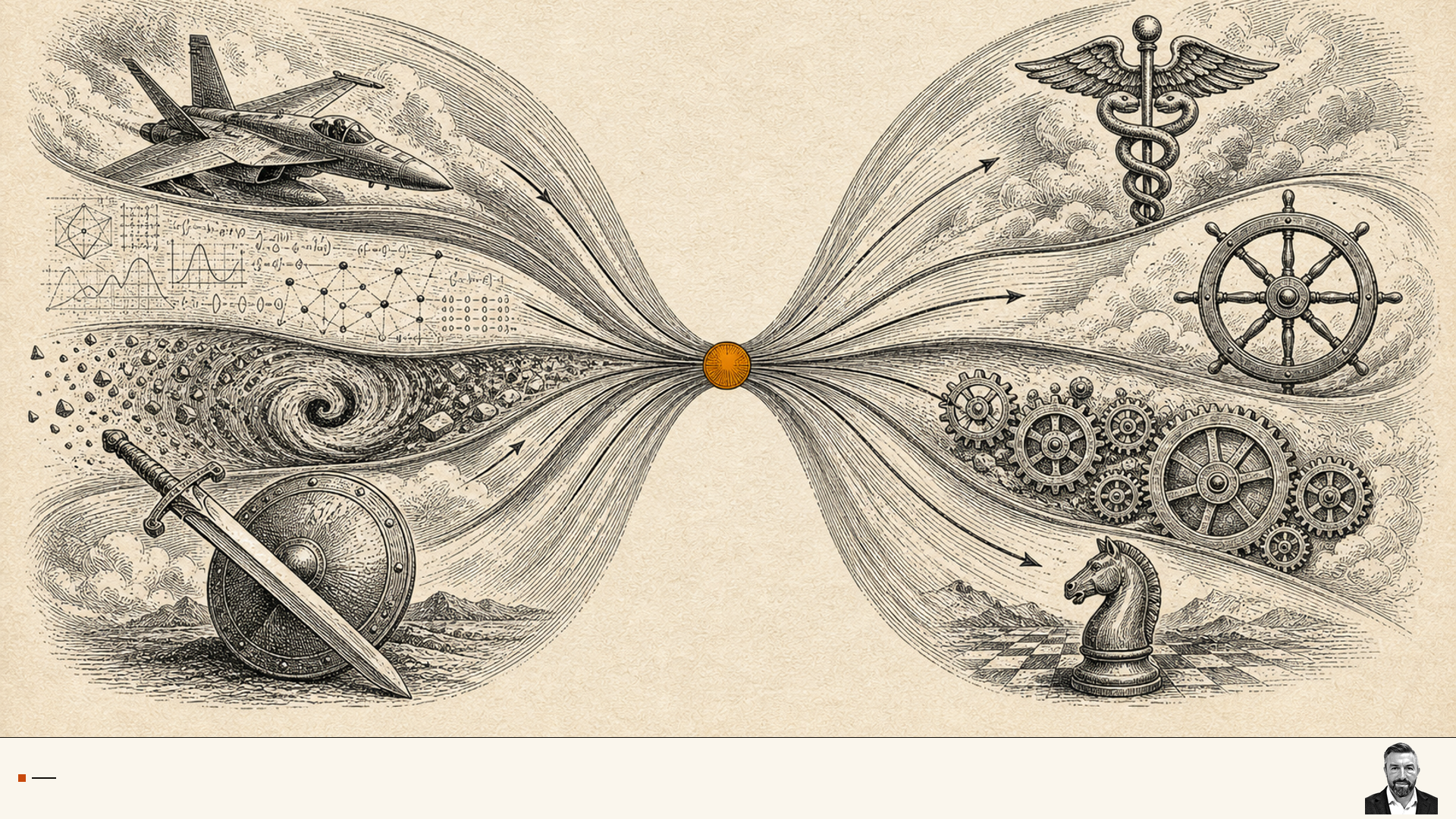
Here is the thing the OODA caricature misses. Boyd did not invent the loop from nothing. He synthesized it.
His 1976 essay “Destruction and Creation” is the tell. To explain how a mind builds and rebuilds its understanding, he reached into Gödel’s incompleteness theorems, the second law of thermodynamics, and Heisenberg’s uncertainty principle. His argument was that any closed mental model decays, the way an isolated system runs toward disorder, and the only fix is to break it open and rebuild it with material from outside. That is orientation, written as epistemology.
So the loop has many fields flowing into it. Air combat. Mathematics. Physics. Military history from Sun Tzu through blitzkrieg. Steve Jobs liked to quote Picasso: good artists copy, great artists steal. Boyd stole. He took from everywhere and fused the parts into one revolutionary idea. In keeping with his spirit, I’m going to steal liberally from him.
This is the part of Boyd worth stealing, and the part I most aspire to myself. His method was his message. He kept his own orientation alive by reaching outside his discipline, which is exactly what his theory tells you to do. The man was a working demonstration of his own loop.
It also explains why his version works across domains when so many others stay locked to one, which is the next part of the story.
The Fan Out
Once you see the skeleton, you see it everywhere.
Pilots are taught to Perceive, Process, and Perform. Drivers learn IPDE: Identify, Predict, Decide, Execute. Nurses run ADPIE. Quality engineers run PDCA, the Plan, Do, Check, Act cycle. Six Sigma teams run DMAIC. Startups run Build, Measure, Learn. Designers run the Double Diamond. A wilderness course teaches you to STOP: Stop, Think, Observe, Plan. I learned a version of that as a ski instructor. Every one of them is observe, orient, decide, act, with the labels changed.
Now the honest part, because this is where a careless version of the argument falls apart.
Not all of these came from Boyd. Many predate him. PDCA goes back to Walter Shewhart in the 1920s and Deming in the 1950s. The intelligence cycle was formalized by Sherman Kent in 1949. The learning cycle behind Kolb traces to Kurt Lewin in the 1940s. The DECIDE model, born from studying emergency response, was published in 1975, a year before Boyd’s essay. The Smith System for defensive driving dates to around 1950. Boyd’s “Patterns of Conflict” did not arrive until 1976.
So my claim is not that everyone copied Boyd. It is better than that. This is convergent evolution. Every field that has to act under uncertainty independently rediscovers the same loop and gives it a local name. The dates prove the independence. Boyd is not the origin of the loop. He is its clearest articulation, and the one who found the part that matters.
Two Rivers Run Into Your Codebase
In software specifically, the loop arrived twice, from two directions.
One river is Deming. Plan, Do, Check, Act flowed out of quality and manufacturing into Lean, then into Agile, DevOps, Six Sigma, and Lean Startup. When your team inspects and adapts each sprint, ships through a pipeline that tests and reverts, runs a blameless postmortem, or watches an error budget, you are drinking from the Deming river, whether anyone says his name or not.
The other river is Boyd. OODA flowed out of conflict and strategy into military doctrine, business competition, and the language of tempo and getting inside an opponent’s decision cycle.
Both rivers run from the same spring, the scientific method, the oldest observe-and-revise loop we have. Modern engineering drinks from both without noticing either. That is not a knock. It is a sign of how deep the pattern goes.
The Part Everyone Drops
Here is what almost every rebrand loses in translation.
Look again at the domain-specific cycles. IPDE for driving. ADPIE for nursing. They work, but they only work in their home domain, because they bake the orientation directly into the steps. A driving checklist comes pre-oriented for driving. It cannot tell you anything about a codebase or a battlefield.
OODA is the one that works across domains, and it does so for a precise reason. It is the only one of these that leaves Orient as an open, fill-it-yourself variable. It does not hand you the answer. It hands you the structure and demands that you supply the orientation for your situation. That is why it generalizes to combat, business, sport, and software alike. The generality and the orientation are the same property.
And that property is exactly what the loop-shaped frameworks tend to flatten. They all keep Observe, Decide, and Act. Orient is the step that gets compressed into a single word or skipped entirely. Boyd’s whole contribution was to insist that orientation is not one of four equal boxes. It dominates the other three. Lose orientation and the loop just helps you be wrong faster.
Which Brings Us to Agent Loops
The newest uniform on the old skeleton is the AI agent loop, and the industry is making the classic mistake at industrial scale. It is obsessed with the loop, the tooling, the cleverness of an agent that fires itself, and it is underinvesting in orientation. A loop with a fuzzy goal and no real success signal does not become intelligent by repeating. It becomes confidently wrong, faster.
The fix is the oldest lesson in the lineage. Give the loop something to orient around. Clear standards. A definition of done it can actually check. Context that points it at the right part of the system. The orientation layer is the work, and it is the part a fighter pilot was lecturing about for six hours at a time while the rest of us were still arguing about the boxes.
That history is also your permission slip. If you have ever wondered whether it is a stretch to apply a strategy from air combat to engineering, look at the fan. A theory that fanned in from thermodynamics, logic, and ancient warfare, and fanned back out to medicine, driving, business, and sport, has already earned the right to sit in your codebase. The breadth is the warrant. You are not borrowing from a foreign field. You are joining a pattern that every serious field already found.
The fighter pilot hiding in your engineering practices has one thing to tell you that the practices themselves forgot. The loop was never the hard part. Orientation wins.
Receipts
- Boyd, the source. Colonel John Boyd co-created Energy-Maneuverability theory with Thomas Christie, led the “Fighter Mafia” group behind the F-16’s lightweight fighter lineage, and his maneuver warfare ideas shaped Marine Corps doctrine MCDP-1. He originated the OODA loop and never published a book, only briefings.
- Synthesis, in his own work. Boyd’s 1976 essay “Destruction and Creation” builds its model of thought from Gödel’s incompleteness theorems, the second law of thermodynamics, and Heisenberg’s uncertainty principle. The loop was synthesized across fields, not invented in one.
- The loop predates Boyd. PDCA traces to Shewhart in the 1920s and Deming in the 1950s. The intelligence cycle was formalized by Sherman Kent in 1949. Kolb’s learning cycle descends from Lewin in the 1940s. The DECIDE model for emergency responders was published in 1975. The Smith System dates to around 1950. “Patterns of Conflict” came in 1976. The pattern is convergent, not copied.
- Two rivers. Most software loops (Agile, DevOps, Lean Startup, Six Sigma) descend from Deming’s PDCA, not from Boyd. OODA arrived through strategy. Both trace to the scientific method.
- Why OODA generalizes. Domain cycles like IPDE, ADPIE, and DECIDE hardcode their orientation and stay in their domain. OODA leaves Orient as a variable, which is why it works across domains, and why the orientation step is the one that matters.