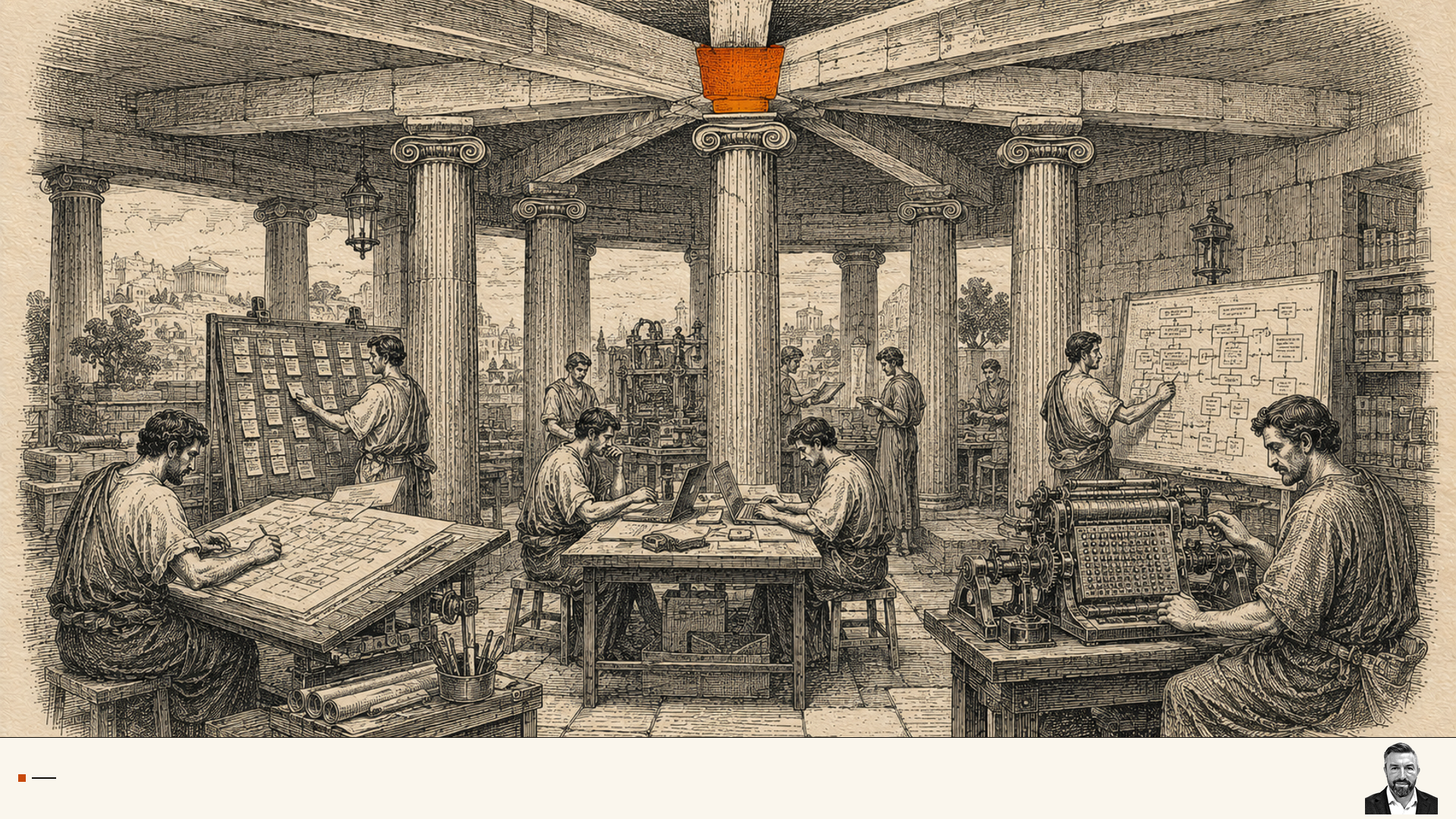
Engineering leadership is not tested when everything is calm. It is tested when production is down, the deadline moves, the customer escalates, the codebase fights back, the team loses confidence, and someone has to make the hard call.
That is when leadership needs more than process. It needs practiced virtues.
Too many developers are promoted from individual contributor roles into management with no real training. They were good at writing code, so someone hands them people, priorities, conflict, budgets, delivery pressure, and organizational risk. Then everyone hopes they figure it out before they damage the team.
I was fortunate. When I moved into management, the company invested in me and sent me to a basic management class. That class did not make me a great manager, but it gave me language, structure, and a starting point.
I was also fortunate to spend my career around executives and managers who showed me what good management looked like. I also had managers who showed me what horrible management looked like. I learned from both. The good ones gave me models to follow. The bad ones gave me warnings to remember.
Over time, I realized the best lessons were not new. They were old human lessons in modern clothing. The Romans were naming versions of these problems more than 2,000 years ago.
I am not interested in cosplaying Rome. I am interested in bringing useful ideas forward. Software is new. Human behavior is not.
Teams still panic. Leaders still avoid hard decisions. Organizations still reward motion over judgment. Smart people still chase preference over discipline. Good intentions still create damage when duty is misordered.
Old virtues still have work to do. This series uses five Roman virtues as a practical language for modern engineering leadership:
- Gravitas: Be the Calm
- Disciplina: Standards Beat Preference
- Constantia: Principles Under Pressure
- Pietas: Duty Is Not Always Gentle (Or Easy)
- Virtus: Courage as Managerial Action
This essay is the map. The individual essays carry the stories, tradeoffs, and scars.
Those stories are not abstractions. Gravitas comes from production outages where panic would have made diagnosis worse. Disciplina comes from real codebases where preference, pattern sprawl, and shiny tools increased cognitive load. Constantia comes from enforcing standards even when an AI agent I was running committed good code directly to main. Pietas comes from removing a harmful employee and from watching misordered compassion damage an entire division. Virtus comes from telling executives that the product they wanted to keep extending had to be rebuilt.
The Latin gives the ideas a frame, and the management scars give them weight.
Gravitas: be the calm
Gravitas is the discipline of steadiness under pressure. When production is down, the team already knows the stakes. They do not need the leader to perform urgency. They need the leader to create enough calm for useful action.
The job is to slow the panic down, name the problem, clarify the next step, assign ownership, protect attention, and communicate clearly. Gravitas does not pretend the situation is fine. It refuses to make the situation worse. Read the full essay on Gravitas.
Disciplina: standards beat preference
Disciplina is ordered practice. It is what keeps a codebase from becoming a museum of every developer’s favorite pattern, tool, framework, and weekend discovery.
A healthy team needs shared conventions, shared patterns, shared definitions of done, and shared expectations for how work moves through the system. That is how you protect cognitive load and make the system easier to change. Read the full essay on Disciplina.
Constantia: principles under pressure
Constantia is consistency when the shortcut becomes attractive. Everyone believes in clear requirements until the deadline is tight. Everyone believes in review until the release is late. Everyone believes in standards until the exception is convenient.
Everyone says they have principles. Your commitment to them shows up when keeping them costs something. If your standards disappear when the pressure rises, the team learns exactly how much those standards were worth. Read the full essay on Constantia.
Pietas: duty correctly ordered
Pietas is usually translated as duty, but for managers, duty never points in only one direction. You owe something to the individual, the team, the business, the customers, and the craft. Sometimes those duties conflict.
That is where management becomes serious.
Duty is more than your set of obligations or your job description. Duty is protection correctly ordered. You protect the person where you can. You protect the team when you must. You protect the business from avoidable damage, customers from instability, and future maintainers from today’s cowardice. Read the full essay on Pietas.
Virtus: courage as managerial action
Virtus gives us a way to talk about courage, excellence, and character without turning leadership into slogans. In engineering leadership, courage is not a personality trait. It is action under pressure when risk, fear, and consequences are real.
Sometimes courage means putting features ahead of the tech debt remediation the team wants. Sometimes it means putting tech debt remediation ahead of the features the business wants. The direction is not the point. The point is whether you will tell the truth about what the situation requires. Read the full essay on Virtus.
Old Virtues, Modern Pressure
The point of this series is not that Latin is magic. It is not. The point is that engineering leadership keeps running into ancient human problems: fear, pride, avoidance, appetite, cowardice, status, panic, and misordered loyalty.
The usefulness of these words is not nostalgia. It is compression. They let you name the leadership failure before it becomes a process problem.
Panic. Appetite. Drift. Avoidance. Cowardice. Misordered duty.
The bugs in the human software.
Those are old problems and they lead to shipped bugs, burnt teams, wasted money, and ordinary pressures turned into organizational damage. Just as in ancient Rome, teams and workers do not need slogans. They need leaders with practiced virtues.
Receipts
- Gravitas: The standalone essay is grounded in production-outage behavior: slowing panic down, preserving clarity, and creating useful action when pressure is high.
- Disciplina: The standalone essay includes codebase examples around UI stack standardization, unfinished migrations, Go versus C# dashboard work, and pattern sprawl.
- Constantia: The standalone essay includes the AI-agent-to-
mainincident where process was enforced even though the generated code was good. - Pietas: The standalone essay includes the financial services employee removal, vacation-efficiency signal, top performers refusing to work with him, and healthcare SaaS division fallout.
- Virtus: The standalone essay includes multiple product rebuild conversations with executives where the right technical recommendation carried political and career risk.