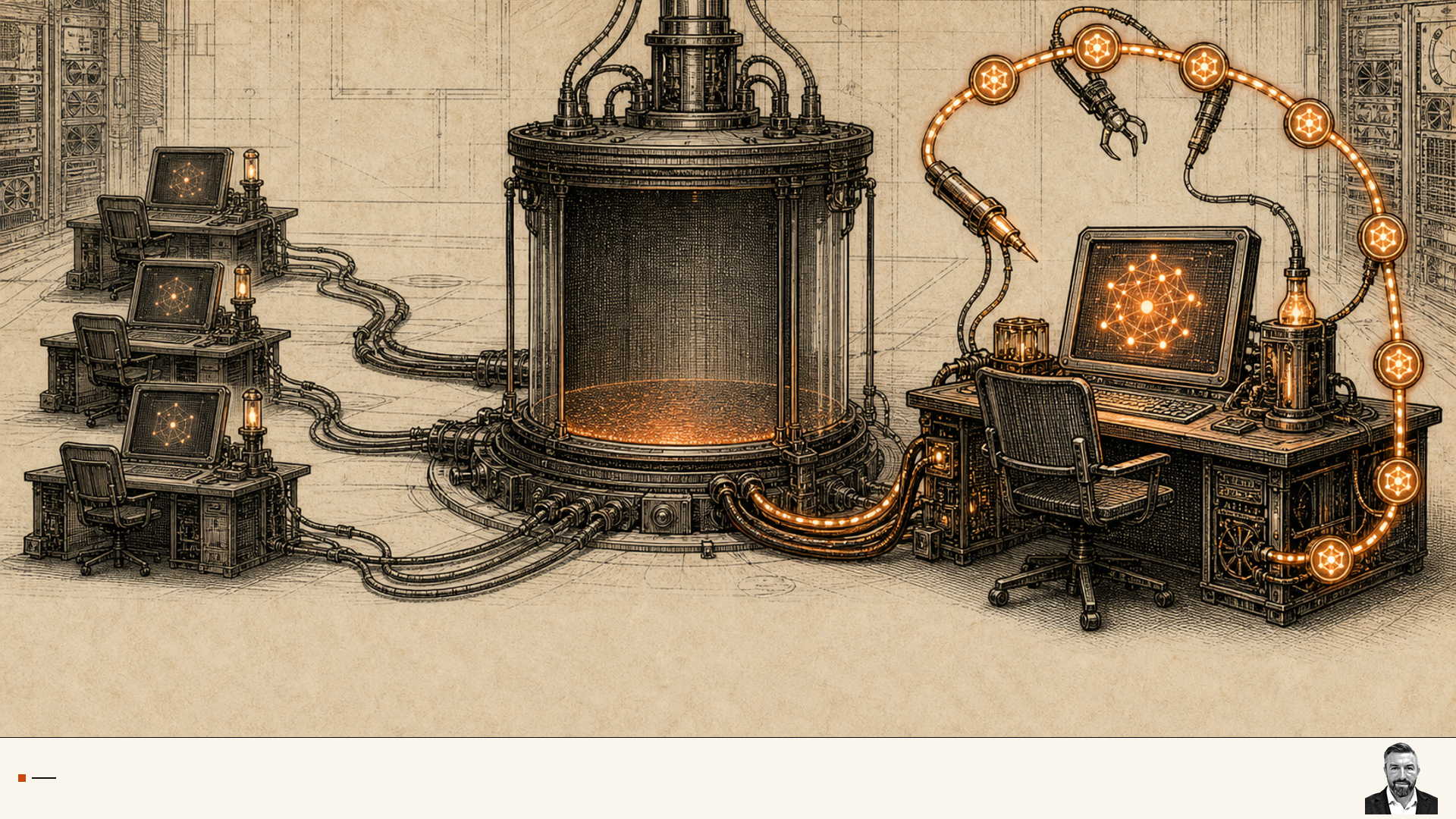
At my current employer, a marketing services SaaS provider, a developer let Opus 4.8 churn on a task for most of a day. The model consumed roughly half the team’s GitHub Copilot credits.
Nothing malicious happened. The developer was trying to get work done. The model was available. The team had paid for access. The product made the expensive choice feel like the normal choice.
Afterward, we changed the policy. The premium model became request-only, and Sonnet 5 became the standard option for normal development work.
That was not an anti-AI policy. It was the moment AI stopped looking like a productivity subscription and started looking like infrastructure.
Shared credits hide a shared resource problem
SaaS taught managers to think about software as a predictable cost per seat. Buy a license. Give an employee access. The next employee costs roughly the same amount.
Agentic AI breaks that mental model. One employee can ask a model to draft an email. Another can ask the same model to read a codebase, run tools, revise a plan, retry failed tests, and keep working for an hour. Both employees may have the same seat. They do not create the same cost.
The underlying resource is not the seat. It is compute.
This is how tragedy of the commons shows up in an AI budget. Nobody has to behave badly. Each person only has to treat a shared resource like a personal one.
Premium models make this more obvious because their output is expensive and their agentic features invite longer work. More context. More tools. More effort. More subagents. More chances to find a better answer. More cost.
That can be a good trade when the work is important, but it is a terrible default for every task.
The product is teaching the wrong habit
Most AI products market the best model as the model you should want. That is understandable. Vendors want users to feel the frontier. They want the impressive demo. They want you to have the moment where the model does something that feels nearly impossible. And each frontier model moves “impossible” further out.
But a business user does not choose a model from a neutral menu. They follow the product’s cues. If the most capable model is easy to select, if the interface frames more reasoning as better reasoning, and if no one sees the shared budget declining, the product is training users to spend a scarce resource as if it were unlimited.
Then the invoice, rate limit, or exhausted team allowance arrives. The usual response is bad: ban the model, cut access, or tell employees to be more careful. That treats the employee as the problem. The system, however, is the problem.
The right answer is a model policy
We did not outright ban premium models. We put them in the right lane.
| Work type | Default | Escalation rule |
|---|---|---|
| Routine coding, drafting, summarization, and analysis | A capable mainstream model | Escalate only if the work stalls or the quality bar is not met |
| Difficult debugging, complex implementation, and high-value research | Premium model | Use when the expected value of a better answer exceeds the cost |
| Long-running autonomous work | Premium model with an explicit budget | Require an owner, a stop condition, and a reason to let it run |
That is not bureaucracy for its own sake. It is basic resource allocation. The policy also has to match the product surface.
On the development side, GitHub Copilot gives us model choice. We can make a mainstream model the default and put premium access behind an explicit request. That is a hard control.
Business users are different. They use the Claude desktop application, where we cannot simply remove the highest-tier model from the menu. We sent an email explaining the models, the work they fit, and when premium capability is appropriate. That education matters. It is still a soft control.
The best enterprise AI products will make the hard control available everywhere. That is the product capability enterprises actually need.
Cost governance is a product requirement
Enterprises increasingly need five controls:
- A default model administrators can choose. Do not let the most expensive model become the accidental standard.
- Per-user and per-team budget visibility and guardrails. A shared allowance should not be exhausted silently by one agentic session.
- Premium approval paths. Exceptional capability should be available without being ambient.
- Task-level observability. Show which workflows consumed cost, which model did the work, and whether the outcome was accepted.
- Automatic routing. Send ordinary work to the cheapest capable model and reserve premium models for tasks that earn them.
Coinbase offers a production example of this approach. In June 2026, CEO Brian Armstrong said the company was defaulting engineers to cheaper open-weight models through its LLM gateway, routing prompts based on the task, cache hits, and model pricing, and making requests cache-aware.
The goal was not to choke off usage. Armstrong said Coinbase cut its AI spend nearly in half while token use continued to rise. That is Coinbase’s own report, not an independent audit, but it makes the point: the best response to a runaway token bill is better infrastructure, not a smaller AI program.
This is where the frontier labs face a product-design problem. They want customers to use their best models. Customers want to enable more employees without giving every employee an unlimited premium-compute budget. Those goals are incompatible unless the platform can distinguish a Toyota workload from a Porsche workload.
The budget shock creates hybrid demand
The first budget shock rarely sends a company straight to an on-premises model cluster. It does something more immediate. It makes the organization ask which work actually needs the frontier model.
Some work moves to a cheaper hosted model. Some stays in the same platform but uses the standard tier. Some gets batched. Some is eliminated because the agent was doing redundant work. Eventually, predictable and sensitive workloads become candidates for hosted open models, dedicated capacity, or local inference.
That is how hybrid AI begins: with a team realizing that one employee can spend half the budget before lunch, not with a grand architecture plan.
Receipts
- First-party operational observation: The Copilot credit incident and the subsequent model policy described here occurred at the author’s current employer, a marketing services SaaS provider. The company name and specific allocation details are intentionally omitted.
- Premium-model pricing pressure: Anthropic lists Claude Opus 4.8 at $5 per million input tokens and $25 per million output tokens. Anthropic.
- Effort changes consumption: Anthropic describes higher effort settings as using more of a user’s rate limits in exchange for deeper reasoning. Anthropic.
- Agentic tasks multiply demand: Gartner estimates agentic models can require 5 to 30 times more tokens per task than a standard chatbot. Gartner.
- Cost control is becoming an enterprise concern: Reporting from the FinOps community describes organizations exceeding annual AI token budgets early in the year and moving toward token controls and observability. TechCrunch.
- Coinbase routing case study: Brian Armstrong said Coinbase was using cheaper open-weight defaults, task-aware routing, caching, leaner context, and spend visibility. He reported that the program cut AI spend nearly in half while token use kept growing. These are Coinbase’s self-reported results, not independently audited measurements. Armstrong’s June 2026 post.