When DeepSeek arrived, the obvious prediction was that local and hybrid AI would take over. The model was cheap, the weights were available, and the gap with closed frontier models looked smaller than many people expected. Surely enterprises would stop renting intelligence from Anthropic, OpenAI, Google, and Microsoft, then run their own models instead.
That did not happen. Open models gained token volume while frontier labs kept taking the spend. Open models did not fail. The prediction failed because a model is not an AI system.
The prediction confused availability with deployability
Downloading model weights is easy. Operating a useful enterprise AI service is not. To replace one frontier-model API call with a serious local or hybrid alternative, a company has to answer questions the API used to hide:
- Where does the model run?
- Which data can it see?
- How is capacity allocated when many employees use it at once?
- How do requests fail over?
- Which model gets a hard task and which gets a mundane task?
- How are prompts, tools, retrieval, permissions, and model changes evaluated?
- Who knows when the system has become more expensive, less accurate, or less safe?
The model is one component inside that system. This is why a frontier API remains so attractive. It gives a team a model, capacity, upgrades, tool integration, billing, and a support boundary in a few lines of code. The buyer pays a premium for convenience, but the convenience is real.
Hardware is a tax, not the whole explanation
Local AI hardware is more expensive than it looked a year ago. Memory manufacturers are moving capacity toward high-bandwidth memory and server products for AI, tightening conventional DRAM and raising the cost of servers, workstations, laptops, and storage. TrendForce projected conventional DRAM contract prices up 58 to 63% quarter-over-quarter in the second quarter of 2026, while S&P Global attributed the pressure to manufacturers favoring higher-margin AI memory over conventional DRAM.
That matters for a company considering a local AI appliance or a fleet of upgraded workstations. The infrastructure bill includes memory, storage, networking, power, cooling, support, and the cost of keeping capacity busy, not just a GPU. Hardware is still not the decisive obstacle for most enterprises. An underused local model is expensive even if the server was cheap, while a well-used managed model can be economical even at a high token rate. The real comparison is total cost of ownership.
The enterprise wants diversification
David Sacks described the problem cleanly on the July 2026 All-In episode. Enterprises would like to diversify away from closed frontier models when they can, but the average enterprise often lacks the technical capability to do it. He pointed to Coinbase and DoorDash as companies that built token-routing middleware capable of sending frontier tasks to frontier models and mundane tasks to cheaper models.
Coinbase shows what that layer looks like in practice. In June 2026, CEO Brian Armstrong said the company was defaulting engineers to cheaper open-weight models through its LLM gateway, preprocessing prompts, routing work based on task, cache hits, and model pricing, and making requests cache-aware. The company built a control plane that can use cheaper and frontier models as the work demands. Armstrong said this cut Coinbase’s AI spend nearly in half while token use continued to grow. That is a self-reported result, not an independent audit, but it is the clearest concrete example of the architecture this essay describes.
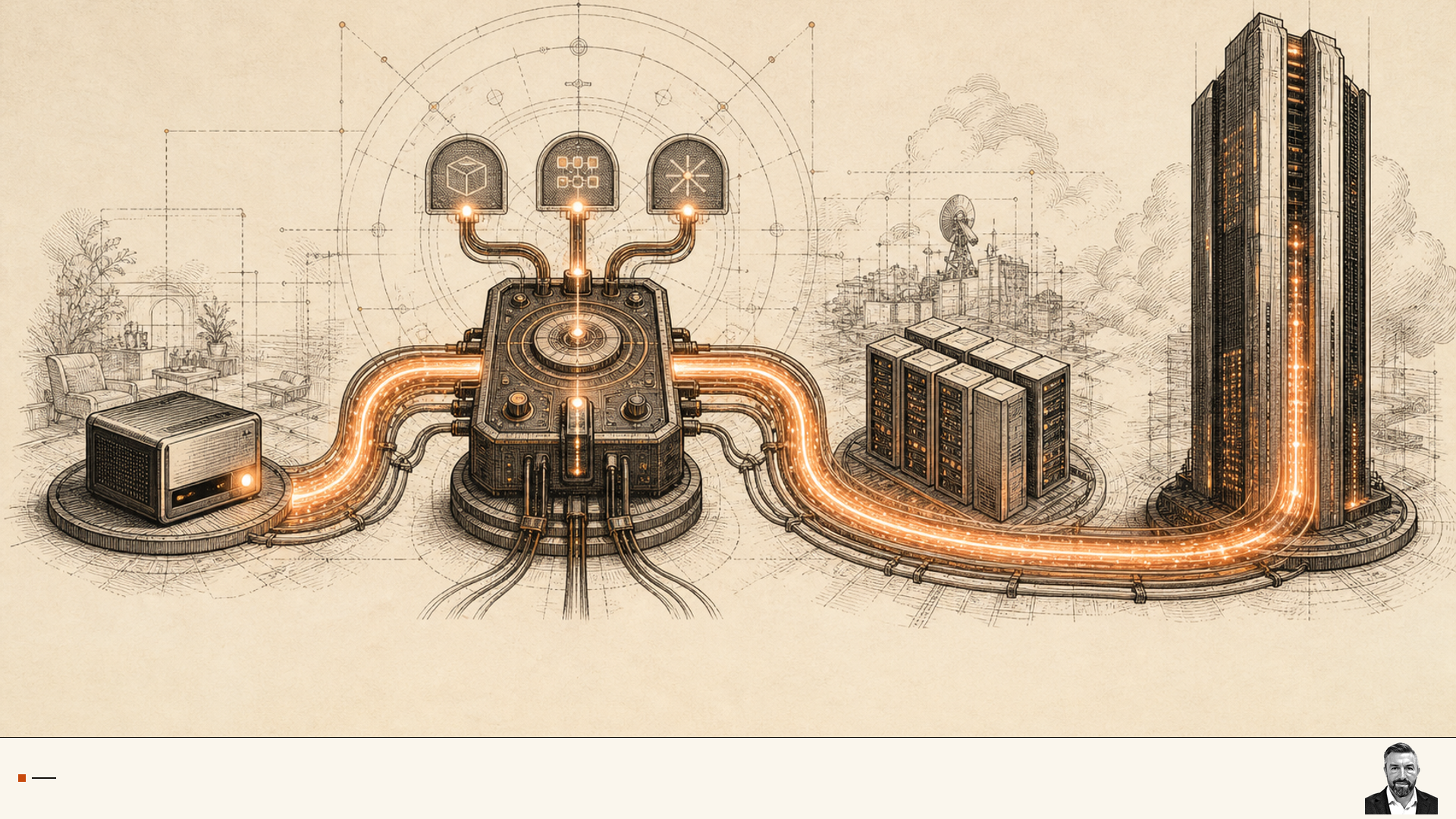
Coinbase is also the exception that proves the problem. It had the engineering capability to build and operate the gateway, routing, cache discipline, and observability layer. Most enterprises still do not. The enterprise does not need to choose between “cloud AI” and “local AI.” It needs a governed control plane that can make a routing decision for each task.
Sensitive, repetitive, high-volume task
→ local or dedicated open model

Routine task with irregular volume
→ lower-cost hosted model

Hard, high-value, or novel task
→ premium frontier model
That routing scheme is hybrid AI in practice: a system that treats model choice as an operational decision instead of a permanent procurement decision.
The wallet-share result is not a refutation
The strange part of the current market is that cheap open models can win volume while frontier labs gain wallet share. Vercel’s May 2026 AI Gateway data makes the split visible: DeepSeek drove 49% of coding-agent tokens but 4% of cost, while Anthropic drove 28% of tokens and 70% of cost. The low-cost model was doing a great deal of work, and the expensive model was doing work customers still valued enough to pay for.
This remains a routing market, not a winner-take-all market. The same data showed cost discipline becoming an explicit routing strategy: teams sent cheap, high-volume work to cheaper models and used frontier models where quality mattered. Google’s newer Flash model saw slower adoption when it arrived at a higher price, while a prior Pro launch spread quickly. Buyers are not rejecting premium models. They are getting better at deciding where the premium belongs.
The real moat is managed delivery
DeepSeek changed the outside option for every closed-model provider. It proved that lower-cost models could clear the production-quality bar for more work than many people expected. That still did not make enterprises eager to own a model-serving platform. The closed labs retain a moat in managed delivery:
- familiar APIs and applications
- stable capacity
- integrated tools and agent harnesses
- model upgrades without hardware replacement
- security contracts and support
- observability and billing
- fewer people required to run the system
The moat is an implementation gap that managed open-model hosting, AI gateways, evaluation platforms, and enterprise routers are trying to close. Every improvement in that layer makes it easier for a company to capture open-model or local-model economics without becoming an inference operator. The future of hybrid AI depends less on the next open-weight release than on whether this layer becomes ordinary infrastructure.
The missing product is a router
The first generation of enterprise AI asked a procurement question: which model should we buy? The next generation asks an operating question: which model should handle this task? That is the difference between buying AI and operating it.
A router needs policies, permissions, cost limits, evaluation data, fallbacks, and an understanding of the task. It needs to know when a local model is available, when a hosted open model is cheaper, when data cannot leave a boundary, and when the work genuinely needs frontier reasoning. Until that product is easy to buy and operate, the average enterprise will keep overusing closed models because the alternative requires too much architecture.
DeepSeek did not make local AI inevitable. It made routing inevitable.
Receipts
- Observed volume versus spend split: Vercel’s May 2026 AI Gateway data reported DeepSeek at 49% of coding-agent token volume and 4% of cost, versus Anthropic at 28% of volume and 70% of cost. This is gateway-specific data, not a complete market census. Vercel Production Index.
- All-In implementation argument: David Sacks discussed enterprise diversification and token-routing middleware, including Coinbase and DoorDash examples, on the July 11, 2026 All-In episode. Episode listing and timestamps.
- Coinbase’s implementation: Brian Armstrong said Coinbase was defaulting engineers to cheaper open-weight models through an LLM gateway, combining routing, cache awareness, leaner context, and spend visibility. He reported that this cut AI spend nearly in half while token use kept growing. This is a self-reported company result, not an independent audit. Armstrong’s June 2026 post.
- Memory-price pressure: TrendForce projected conventional DRAM contract prices up 58 to 63% quarter-over-quarter in Q2 2026, citing AI-server demand and tight supply. TrendForce.
- Why standard memory is affected: S&P Global reported that manufacturers are shifting production capacity to high-bandwidth memory for AI data centers, tightening conventional DRAM supply and raising prices. S&P Global.
- Migration complexity: A company that moved core workloads to DeepSeek V4 reported major savings, but Axios reported that the migration took months and more engineering work than expected. Axios.