“History doesn’t repeat itself, but it often rhymes” - Mark Twain
I see another rhyming verse coming. The evidence is in multiple signals: historical patterns, hardware changes, software distribution shifts, local-model progress, and enterprise sovereignty arguments all point in the same direction. We are in the mainframe era of AI, and that era is ending.
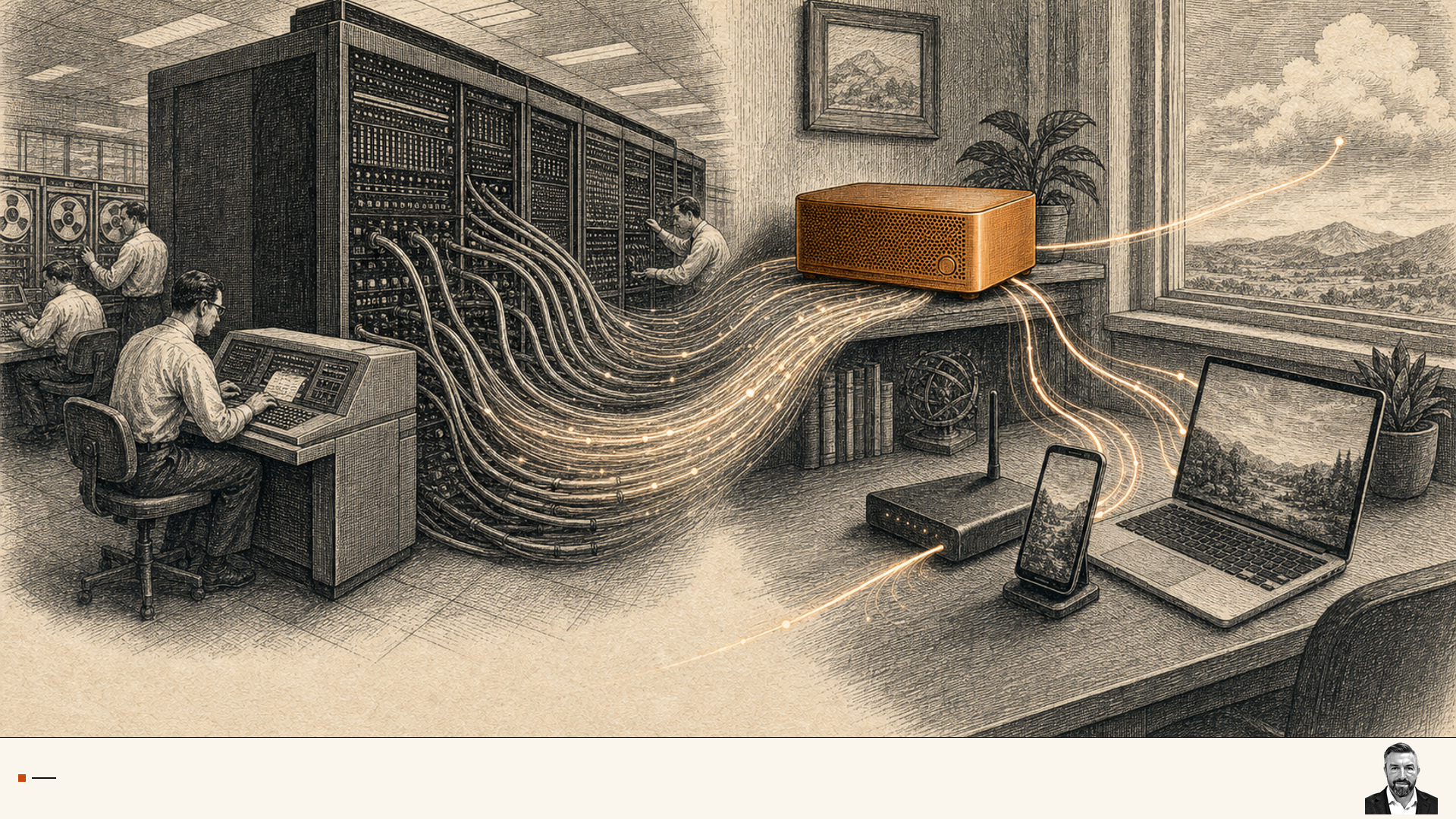
Mainframe conjures an image of a giant computer in a room with a few terminals where people can work. That feels foreign compared to the small, intimate browser and app-based interactions we are used to with AI. You open a browser, type into a chat box, and receive an answer that feels like it belongs to you. However, the infrastructure supporting the intelligence behind that experience is anything but small and intimate.
The intelligence lives somewhere else. It lives in data centers, GPU clusters, power contracts, cooling systems, networking fabric, and software stacks most users will never see. You are not using artificial intelligence the way you use a spreadsheet on your laptop. You are sitting at a terminal connected to a very large and expensive machine somewhere far away.
That is not a criticism. It is the natural starting point for a new computing era. Frontier AI had to begin in the data center because the hardware demands were absurd, the models were enormous, and the software stack was specialized.
Mainframes were real infrastructure. They made serious computing possible before personal machines were viable. Cloud AI is doing the same thing for intelligence.
The Pattern Is Familiar
Computing has been through this cycle before. At first, the machine is large, centralized, expensive, and controlled by a small number of organizations. Users access it through terminals. The machine is too costly for ordinary people, too specialized for ordinary offices, and too important to decentralize.
Then hardware improves. Components get smaller. Memory gets cheaper. Software gets more efficient. The work that once required a central machine starts moving outward.
Mainframes gave way to minicomputers. Minicomputers gave way to personal computers. Personal computers connected to servers. Servers moved into the cloud. Cloud workloads moved back toward the edge when latency, privacy, cost, and reliability demanded it.
Centralized computing remains important, but it stops being the only place important work can happen. AI is starting to move through the same curve.
Centralized AI Was Inevitable
The current AI market is centralized because it has to be. Training frontier models requires massive capital, specialized chips, power, cooling, networking, research teams, and operational skill. Running those models at scale is also expensive. Every prompt consumes scarce compute. Every token produced carries cost. Every product built on top of a frontier model is ultimately renting time on someone else’s industrial machine.
That is why the economics feel strange for most of us. Users pay for something that feels like a software subscription, but the underlying product behaves more like rationed access to a scarce resource. Session limits, usage windows, and credit systems rhyme with booking time on a mainframe. These restrictions are not accidents. They are symptoms.
We are not paying the true marginal cost of unlimited intelligence. We are paying packaged, subsidized, smoothed-over access to a resource everyone wants and few companies can produce at scale. That centralization has created the illusion that AI must live in the cloud forever. It will not. The cloud is where AI had to start. It is not where all AI has to stay.
The Hardware Is Moving Downward
Apple’s Mac Studio is providing one of the early signals here, and it arrived before the current wave of AI-PC positioning became obvious. The Mac Studio matters because of unified memory. For local AI, memory is often the limiting factor. A model that cannot fit close to the processor does not matter, no matter how impressive the chip looks on a benchmark slide. Apple Silicon put large pools of memory close to the CPU and GPU in a way that made serious local inference more plausible on a machine a developer, small team, or serious hobbyist could actually own.
That is why high-memory Mac Studios became interesting to the local AI community. Apple now markets Mac Studio with M3 Ultra around large language model throughput, and ServeTheHome called the 512GB unified-memory Mac Studio “the local AI play” in 2025. Apple seems to believe that serious AI work belongs on machines people can own, including machines close to the home. That is an indicator of what may come next: put enough memory close enough to the processor, and workloads that used to require more exotic hardware begin moving down into machines people can buy.
Chip makers are also creating consumer-level, local AI-focused hardware. AMD Ryzen AI Max+ platforms are being positioned for local AI development and inference with unified memory configurations that can support models up to 200B parameters. That does not mean an ordinary family is replacing Claude at home tomorrow. It does mean that serious local inference is moving from fantasy to product category.
AMD is not describing a science project. It is describing the workload this class of machine is meant to host. AMD’s own ROCm write-up shows Qwen3.5 running locally across 9B, 35B-A3B, and 122B-A10B variants on a Ryzen AI Max+ system, with the 122B model loading across the unified memory pool.
This level of model is exactly what machines like the AMD Ryzen AI Max are designed to host: not frontier-cloud replacement, but serious local inference. For developers, the 35B-class model is the obvious near-term use case: capable enough to handle meaningful coding work locally, small enough to run without treating every prompt like a cloud bill.
NVIDIA DGX Spark points in the same direction from the other side of the market. NVIDIA describes it as a personal AI supercomputer with 128GB of coherent memory, built for prototyping, fine-tuning, and running large models locally.
AMD and NVIDIA are approaching the problem from different positions. AMD is pushing high-capacity unified memory into compact systems. NVIDIA is pushing its GPU, software, and AI infrastructure stack closer to the desk. Jon Peddie Research has already framed NVIDIA’s move as entering the PC chip market, which is the point. This is not just a workstation story. It is a platform story. The AI PC is not a gimmick if it becomes the place where most inference runs by default.
The important idea, however, is not that local machines will beat frontier models across every benchmark. They do not need to. Local models only need to become good enough for enough daily work that cloud AI stops being the default answer to every problem.
The local frontier will keep moving up. Today, a 200B model at home sounds enormous. One day, it may sound like a 486 computer or a 14.4 baud modem. Impressive for its moment. Quaint in hindsight.
The same pressure is coming from the model side. Unsloth’s GLM-5.2 GGUF release packages a 754B-parameter open model into quantized builds as small as 217GB to 239GB, with local serving instructions for llama.cpp, Ollama, LM Studio, vLLM, and other tools. That is not ordinary consumer hardware yet, and it is above the standard 128GB Ryzen AI Halo memory target without additional tricks. It is high-end workstation and local appliance territory.
That is still the point. Local AI is being squeezed from both sides: smaller models are getting more capable, and enormous models are getting easier to run. The work that belonged unmistakably in the data center is moving into hardware a serious developer, team, or small business can plausibly own.
The Browser Is Already Becoming an AI Runtime
Local AI will not arrive only through dedicated hardware. It is already arriving through software distribution. Google is putting Gemini Nano behind Chrome’s built-in AI APIs. Chrome’s Prompt API gives web applications access to an on-device model after the model is downloaded locally. Summarization, writing, rewriting, translation, language detection, and prompt-driven tasks start becoming browser capabilities rather than remote API calls. That matters because Chrome is not just an application. It is distribution.
If the browser contains a local model, every website becomes a potential AI surface without every website owner needing to pay for inference. The browser becomes a local AI runtime. The website provides the workflow. The model provides the assistance. The cloud only needs to get involved when the local model can’t do the job. That is a major shift in the architecture of AI products. The browser becomes the terminal again, but this time the terminal has intelligence of its own.
The AI Box in the Closet
The browser is only one path. The more interesting path may be a local AI box on the network. Not every device needs enough RAM, GPU capacity, and thermal headroom to run a serious model. That would be wasteful. A more likely pattern is one capable local machine in the house, office, or small business, with other devices talking to it over Wi-Fi or Ethernet. Your phone does not need to run the 200B model. Your smart speaker does not need to run the 200B model. Your laptop may not need to run it either. They need to talk to the box that can.
That pattern is already familiar. The router handles network traffic. The NAS stores files. The media server streams video. The home automation hub coordinates devices. A local AI appliance would become the inference hub.
The consumer voice-assistant version of this is still prediction, not current fact. I am not claiming the next version of Alexa or every smart speaker will suddenly become a front end to your private local model. But the underlying architecture is already starting to appear in developer tools, routing products, sandboxed agent systems, and local-inference workflows.
Voice assistants do not need to be the AI. They can be microphones, speakers, and command surfaces for the AI running elsewhere on the local network. The local AI box becomes the thing your devices ask before they call the cloud.
That routing problem is already being solved for. Bifrost documents governance routing across providers, models, keys, load-balancing weights, and automatic fallbacks. It also points to routing rules that can depend on request attributes, budgets, and request complexity. That is exactly the kind of layer hybrid AI requires: not one model call, but a control plane that decides which model is allowed, which model is cheapest, which model is available, and which model is good enough for the work.
NVIDIA is documenting the same kind of control plane inside OpenShell. Its inference.local endpoint routes model requests through a privacy router, strips sandbox-supplied credentials, injects approved provider credentials, applies configured model choices, and forwards requests to managed model endpoints. That is not merely “call an API.” It is governed inference routing designed for agents running in sandboxes.
It is also becoming open-source research and tooling. LLMRouter, from UIUC’s ULab, describes itself as an open-source library for LLM routing. It supports dynamic model selection based on task complexity, cost, and performance requirements, and it includes multiple router strategies. More importantly for this argument, it supports locally hosted OpenAI-compatible inference servers such as Ollama, vLLM, and SGLang. That is the hybrid shape in code: cloud models, local models, and a router deciding where the request belongs.
There are grassroots versions of the same idea, too. A post in the Ollama community describes local coding agents running through a privacy router that intercepts inference calls and sends them to a local Ollama instance, with a hybrid option for switching between local and cloud. That is a community signal, not proof. But it points in the same direction: developers want the workflow of agentic tools without automatically sending every prompt, file, and codebase context to a cloud provider.
That combination matters. Products are already coming to market, major vendors are documenting routing architectures, open-source projects are exploring model selection, and users are asking for local-first control. This is not one person imagining a future from the woods. It is a set of market signals starting to rhyme.
This is not only a hobbyist or local-hardware argument. It is becoming an enterprise sovereignty argument, and it points away from total dependence on the big cloud AI control planes. Microcomputers did not become a household force all at once. They became useful in workplaces first, then moved into homes in a major way later. Enterprise AI ownership may follow the same path.
Another signal: in a recent, semi-viral clip, Palantir CEO Alex Karp talks about what customers should want from AI infrastructure and how businesses should operate. Karp argues that customers should want control over compute, models, data stack, and proprietary advantage. They should know they own the means of production. That becomes much easier when they own, control, or directly govern the box in the closet. The messenger matters. This was not a random product marketer floating a positioning idea. It was the CEO of a multi-billion dollar corporation with major stakes in the future of AI.
Read that with the proper caveat. Palantir has a commercial interest in selling sovereign AI infrastructure, and Karp is not a neutral observer. But that actually reinforces the point. Enterprise vendors are starting to sell control, not just access. The buying conversation is shifting from “which cloud model is best?” to “who controls the stack our business depends on?” When customers worry about data, pricing, intellectual property, and strategic dependency, the answer is no longer only a better cloud model. The answer is more ownership of the stack.
This may be an early microcomputer moment for AI: not because it proves every home will run a serious local model tomorrow, but because it shows serious customers asking, “who should control the machine?”
Most Work Does Not Need the Biggest Model
The future of AI will not be determined only by the best model in the world. Most work does not need the best model in the world. Summarizing meeting notes does not require the frontier. Cleaning up a document does not require the frontier. Searching personal files does not require the frontier. Drafting a routine email does not require the frontier. Many coding tasks do not require the frontier either, especially when the local model has access to the repository, standards, tests, and recent context.
That last phrase matters more than the benchmark chart. A smaller model with the right local context can be more useful than a stronger remote model that has to reconstruct the world from a prompt. In software teams, the useful context is often mundane: coding standards, architecture decisions, database conventions, story format, test commands, deployment constraints, and the recent shape of the codebase.
I would not hand every task to a local model. I would still escalate difficult architecture questions, high-risk migrations, subtle production incidents, and large cross-system reasoning to the strongest available model. But a lot of daily work is not that. A lot of daily work is applying known standards to known systems with enough care to avoid creating new debt.
This is where people get the argument backward. They ask whether a local model can beat the largest cloud model. That is the wrong standard. The right standard is whether the local model is good enough for the work in front of it.
If the local model can handle 70% of daily tasks with lower latency, better privacy, no per-token anxiety, and no dependency on cloud availability, then the cloud model becomes an escalation layer. You still use it. You just do not use it for everything. That changes the economics. The cloud stops being the default place where all intelligence happens. It becomes the premium place where harder intelligence happens.
For an engineering organization, that would be a practical shift, not a philosophical one. If a local model can review routine code against company standards, draft test cases, summarize logs, explain unfamiliar modules, and prepare first-pass story breakdowns without sending sensitive context outside the organization, the team gains options. Some work stays close. Some work escalates. The expensive model is reserved for expensive thinking.
The Future Is Hybrid
The likely future is not fully local AI or fully cloud AI. The likely future is hybrid with small models running directly on phones, browsers, laptops, and operating systems while larger local models will run on workstations, home servers, office boxes, and team-level appliances. Frontier models will run in cloud data centers. The question becomes routing. Which task belongs on the device? Which task belongs on the local network? Which task deserves the frontier model? Which task contains sensitive data that should not leave the building? Which task is worth paying premium cloud prices to complete?
That routing layer becomes one of the most important pieces of the AI stack. But routing probably will not remain a separate switchboard bolted onto the side of the system. It may be a model in its own right: an orchestrator that understands the task, knows the available models, checks local capacity, weighs cost and privacy, and decides where the work belongs.
The early harness experiments point this way. OpenClaw and homebrew harnesses are not interesting because every company should run them tomorrow. They are interesting because they show the shape of the problem. The valuable layer is not just the model. It is the thing that can discover tools, discover context, discover available models, and route work intelligently across them.
That may look like a flavor of MCP for models: a discovery layer where local and cloud models advertise what they can do, what they cost, where they run, what data they are allowed to see, and how they should be called. The local model may not simply answer the prompt. It may decide that another model should answer it. Ask a question on your phone, and the first pass may happen on the small model running locally. That model may pass some or all of the work to the AI box in your house. The box may handle the task itself, split the work across local models, or call a frontier model in the cloud for the part that genuinely needs it.
The winning product may not be the one with the largest model. It may be the one that knows when to use the small model, when to use the local box, and when to call the cloud. The future is not one enormous model in the sky. It is a personal model close to you, calling a bigger model when the work justifies the cost.
Lock-In Will Be Attempted
This future will not arrive as an open utopia. Platform companies do not work that way. Apple will want local Apple intelligence calling Apple cloud intelligence. Microsoft will want Copilot on the device calling Microsoft cloud models. Google will want Gemini woven through Chrome, Android, Workspace, and its cloud stack. NVIDIA will want the hardware, runtime, developer tools, and cloud path to feel like one coherent system. That is not evil. It is platform strategy.
Once local AI becomes the client for cloud AI, every major vendor will try to own the client. They will make their local model the preferred front door to their cloud model. They will tune the experience so their browser, operating system, IDE, app suite, and model feel like one product. Some of that integration will be genuinely useful. Some of it will be lock-in wearing a convenience costume.
We have seen this before. IBM created the PC standard, watched the clone market take off, then tried to regain control with Micro Channel Architecture. MCA was technically sophisticated and strategically obvious. It also failed because the market wanted compatibility more than IBM wanted control. AI will hit the same wall.
Users will not want five assistants with five separate memories. Businesses will not want every workflow trapped inside one vendor’s model. Developers will not want tools that only work if the local model and cloud model come from the same company. Lock-in will be attempted because lock-in is always attempted. It will fail where interoperability matters more.
Local AI Changes Where Leverage Lives
Centralized AI gives leverage to infrastructure owners. Local AI moves some of that leverage back toward users, teams, and organizations. If you can run meaningful models locally, you gain options. You can process private documents without sending them to a vendor. You can keep personal or organizational memory close to the source. You can reduce cloud spend. You can continue working when a cloud provider has an outage, changes pricing, changes terms, or throttles usage. You do not eliminate dependency on frontier models. You reduce dependency on them. That distinction matters.
Cloud AI will still be extraordinary. It will still have the best models first. It will still handle the largest contexts, hardest reasoning, newest capabilities, and most compute-heavy workloads. Enterprises will still pay for managed security, compliance, support, scale, and integration. The cloud does not lose because local models become better than frontier models. The cloud loses default status because local models become good enough for most work.
The Mainframe Era Ends Gradually
Mainframes did not vanish when personal computers appeared. They changed roles. They remained valuable for work that required centralization, reliability, transaction volume, and operational control. The PC did not kill every mainframe. It killed the assumption that serious computing had to be centralized. That is where AI is headed.
Frontier models will not disappear. The largest labs will continue pushing the boundary. The biggest models will still matter for research, science, enterprise automation, autonomous agents, multimodal systems, and high-value reasoning. But the assumption that intelligence must be rented from a remote data center for every task will weaken.
First slowly. Then quickly. The local model will write the first draft. The local model will summarize the meeting. The local model will search the files. The local model will watch the application logs. The local model will inspect the codebase. The local model will decide whether the cloud model is needed. The cloud model becomes the expert you call in. Not the employee sitting next to you for every routine task.
The Thing to Watch
Do not watch only the benchmark charts. Watch where the model runs. Watch how much memory ships in ordinary machines. Watch whether local inference boxes become normal in home labs, small businesses, and development teams. Watch whether browsers, operating systems, and IDEs expose local model APIs. Watch whether model memory becomes portable. Watch whether users start caring about local-first AI the way they learned to care about local files, local backups, and local networks.
The technical question is not whether the local model can beat the frontier model. The business question is how much work stops needing the frontier model at all. That is how mainframe eras end. Not with one dramatic replacement, but with a thousand ordinary tasks moving closer to the user.
Receipts
- Apple Mac Studio architecture: Apple’s Mac Studio page positions the M3 Ultra version around demanding professional AI workloads, including LLM throughput, and emphasizes Apple Silicon, high memory bandwidth, and on-device processing.
- Mac Studio as a local-AI signal: ServeTheHome described the 512GB unified-memory Mac Studio as a local-AI play in 2025, arguing that the memory footprint mattered even where raw GPU comparisons were more nuanced.
- AMD Ryzen AI Max+: AMD positions Ryzen AI Max+ systems for local AI development and inference, with unified memory configurations intended to support models up to 200B parameters.
- Qwen3.5 on AMD hardware: AMD’s ROCm testing shows 9B, 35B-A3B, and 122B-A10B Qwen3.5 variants running locally on a Ryzen AI Max+ system.
- NVIDIA DGX Spark: NVIDIA describes DGX Spark as a personal AI supercomputer with 128GB of coherent memory for prototyping, fine-tuning, and local inference.
- NVIDIA entering the PC market: Jon Peddie Research frames NVIDIA’s platform expansion as an entry into the PC chip market.
- Quantized large models: Unsloth’s GLM-5.2 GGUF release packages a 754B-parameter open model into quantized builds as small as 217GB to 239GB, with instructions for several local serving tools.
- On-device AI in Chrome: Google’s documentation covers Chrome’s built-in AI APIs and the on-device Prompt API powered by Gemini Nano.
- Routing is already a product category: Bifrost’s routing documentation covers provider/model restrictions, weighted load balancing, automatic fallbacks, cost management, access control, and routing based on runtime attributes.
- Major-vendor routing signal: NVIDIA OpenShell inference routing documents
inference.local, a sandbox-local endpoint that routes model requests through a privacy router, strips sandbox-supplied credentials, injects configured backend credentials, and forwards requests to managed model endpoints. - Open-source routing research and tooling: UIUC ULab’s LLMRouter supports dynamic model routing based on task complexity, cost, and performance, includes multiple router strategies, and supports locally hosted OpenAI-compatible inference servers such as Ollama, vLLM, and SGLang.
- Local-agent routing community signal: A Reddit post in r/ollama describes routing coding-agent inference calls to local Ollama, including zero-cloud-egress policies and hybrid local/cloud switching.
- The history of attempted lock-in: The Electronic Frontier Foundation’s history of IBM Micro Channel Architecture documents IBM’s attempt to regain control of the PC standard and the market’s preference for compatibility.
- Enterprise sovereignty signal: In an official Palantir post featuring Alex Karp, Karp argues that technical customers want control over their compute, models, data stack, and proprietary advantage.