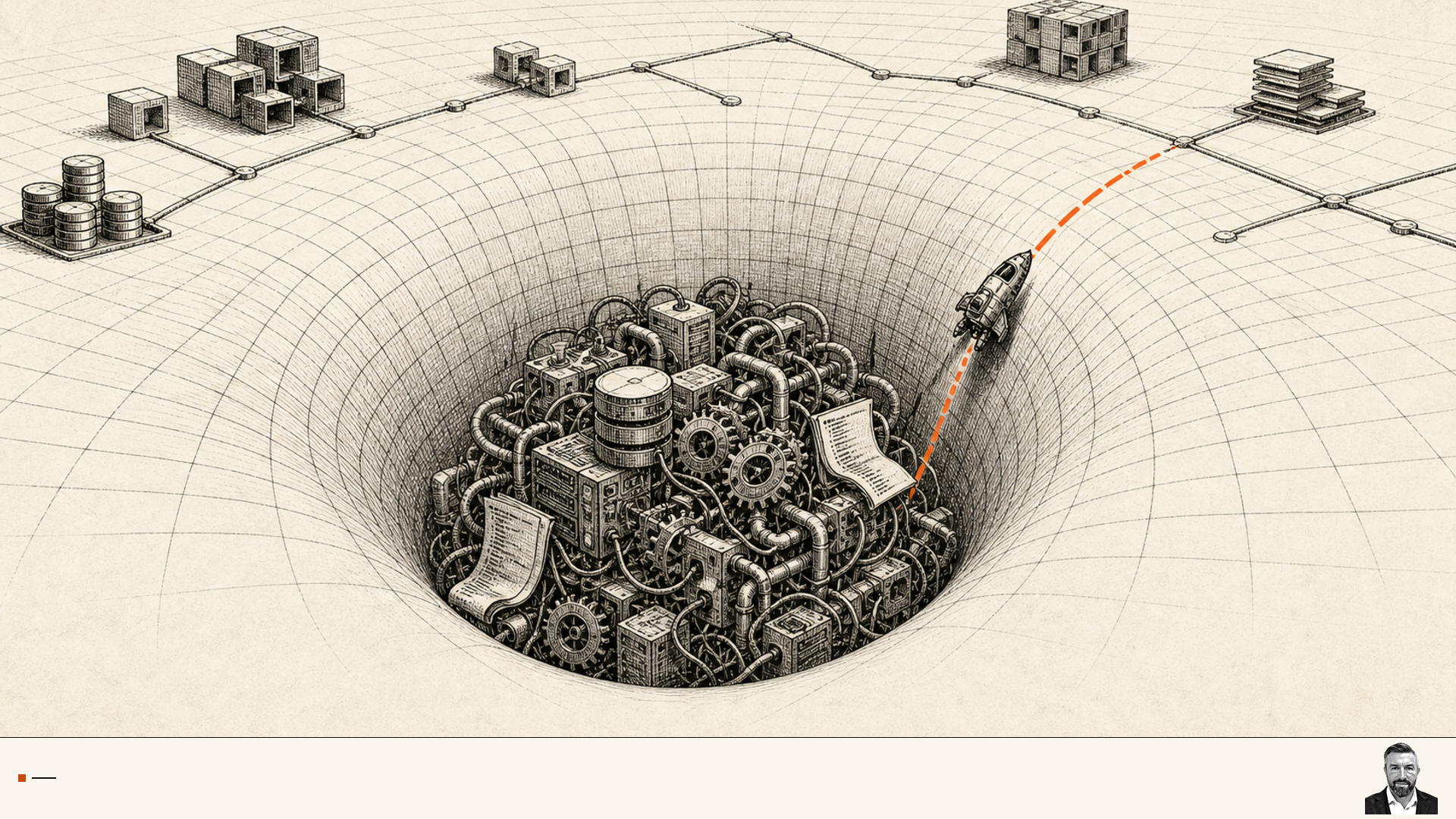
Technical debt starts as drag. The team moves a little slower. A change takes longer than it should. A small feature touches too many files. A bug appears in a place everyone already knows is fragile. The release needs more caution. The estimate gets padded because the old part of the system is involved.
That drag matters, but drag is still manageable. You can push through it for a while. You can accept it for a release. You can make a business decision to carry it because the market opportunity, customer commitment, or learning value is worth the cost.
Eventually, the tech debt builds up to a point where it’s not drag, it’s gravity.
That is a different problem. When a team falls into a technical debt gravity well, normal feature delivery does not get it out. The team can still move, ship, and appear productive from the outside, but most of the energy is spent moving inside the well instead of climbing out of it.
The team can go forward. It can go deeper. It cannot easily regain the ability to maneuver.
Gravity Changes The Shape Of Work
In Your Team Is Fast. Can It Turn?, I wrote about Energy-Maneuverability theory and the difference between speed and maneuverability. A team can be fast in one direction and still be fragile when the road changes. That piece was about spending maneuverability. This piece is about what happens after the spending compounds.
Technical debt is not just mess in the code. It is lost optionality, spent altitude, and future work made more expensive by past decisions that were never revisited.
Early debt feels like friction. Mature debt changes the physics of the system. The codebase starts pulling new work into the same bad shapes. The team makes the same compromise again because the surrounding system makes every other choice expensive. New features conform to the old patterns because escaping those patterns would take longer than the feature itself.
That is the gravity well. The business sees motion and assumes progress. Tickets close. Releases happen. Customers get something. The roadmap moves. Inside the team, the experience is different. Every feature starts with archaeology. Every estimate has an invisible risk premium. Every change requires remembering why the system is weird. The best developers spend more time navigating constraints than creating leverage.
You are still moving.
You are not climbing.
Signs Your Team Is In The Well
A team in a debt gravity well usually knows something is wrong long before it has language for the problem. Small changes require large surface area. A minor behavior tweak touches ten, twenty, or forty files because the logic lives everywhere. Testing becomes a nightmare because the same concept has slightly different forms in different parts of the system.
Estimates get defensive. Developers stop estimating the work itself and start estimating the risk of touching the surrounding system. The phrase “it depends what we find” becomes common because discovery has become part of every task.
Bugs cluster around the same subsystems. Everyone knows the dangerous area. Everyone knows which jobs fail, which tables are painful, which services are fragile, and which parts of the codebase require one specific person. New work creates more cleanup work. Every feature ships, but it leaves another seam, another exception, another duplicate path, another place where the team will have to remember the compromise later.
The most dangerous sign is resignation: “That is just how this system works.” When that sentence becomes normal, gravity has become culture.
False Escape
Teams often mistake movement for climbing. Shipping another feature is movement. Closing more tickets is movement. Adding people is movement. Running harder is movement. None of those guarantee altitude.
If the team keeps adding features in the same fragile pattern, it may be moving faster while going deeper. If the team adds people without improving the architecture, it may be adding coordination cost to a system that already cannot absorb change. If the team asks the best people to heroically fix everything while normal feature pressure continues unchanged, it may simply be burning its strongest engines.
This is where leadership gets tested. The question is not “are we busy?” The question is whether the energy we are spending is restoring maneuverability.
Escape Requires Thrust
You do not drift out of a gravity well. You climb out by spending deliberate energy in the right direction. In software, that energy can take several forms: focused remediation, architecture cleanup, tests around dangerous areas, process repair, migration work, platform investment, documentation, standards, and sometimes replacement.
None of that is free. That is the point. Escaping debt gravity requires leadership to admit that some energy must be spent climbing instead of pretending every sprint can be measured only by new feature output. A feature factory hates this because climbing does not always look like customer-visible progress. Mature engineering leadership understands that future progress depends on restoring the ability to move.
There are four common ways out.
1. The Team-Wide Burn
The cleanest escape pattern is a dedicated team-wide effort to reduce the debt. At a systems control panel vendor, we spent a full month focused on fixing bugs. New feature work totally stopped. The point was not to make engineers feel better about the code. The point was to pay down enough principal that the team could recover capacity for future product work.
This kind of burn works when the debt is broad, visible, and already reducing delivery. The business has to understand the trade. For a defined period, the team stops pretending that every hour can go to new capability. The team spends energy climbing.
The upside is focus. Everyone knows what the remediation period is for. The work is visible. The results can be measured in fewer defects, fewer interruptions, lower support burden, and a cleaner path for later features.
A concentrated burn does not have to last a month. It could take six months, a year, or longer. A former developer of mine later led a team at another company through an eighteen-month rebuild of its core application. The defining characteristic is not the duration. It is the organization’s explicit decision to concentrate meaningful capacity on escaping the well.
The downside is that feature delivery slows while the burn happens. At a healthcare SaaS provider, the organization started a MongoDB-to-Postgres migration, completed roughly half of it, hit the difficult parts, and returned to being a feature factory. A bridge application was created to keep the two databases synchronized, and it became one of the platform’s most common sources of bugs and production outages.
The organization spent the energy required to begin climbing, but it stopped before regaining maneuverability. It got the worst of both worlds: the cost of a major migration and the lasting fragility of a system trapped between two databases. I explore that failure in more detail in The Disciplined Codebase.
A team-wide burn requires executive patience, and that patience has to be earned with a business case.
2. The High-Performer Burn
Another escape pattern is assigning the hardest remediation work to the strongest people. This can work. The best engineers often have the judgment to untangle old systems, rebuild dangerous parts, identify the real seams, and make technical decisions that less experienced developers would miss.
It is also risky.
Do not confuse heroics with escape velocity.
A high performer can create thrust. They cannot always create escape velocity alone. If the work is too large, too tangled, or too poorly bounded, one strong developer may make real progress and still fail to change the business experience. The system is slightly higher in the well, but functionally not high enough to maneuver.
That failure creates a dangerous narrative: “They could not deliver.” Maybe. Or maybe the organization handed one person a problem that required the sustained effort of an entire team.
The developer may have done good work. The architecture may be better. The dangerous area may be partially improved. But if the business needed a visible recovery and the work could not be delivered in the time available, frustration will land on the person instead of the strategy.
That is how teams burn out their best people. They treat top performers like disposable booster rockets, then act surprised when the climb was not enough.
Use this approach only when the debt is well-bounded enough for one person or a small group to actually resolve. If the escape requires product sequencing, QA support, migration planning, architecture governance, team-wide standards, or executive patience, do not pretend it is an individual assignment. It is not.
3. Add Engines
Sometimes the right answer is to add capacity. At a marketing services SaaS provider, we brought in a contractor to redo work that had been built years earlier. That is a money-for-energy trade. The organization admitted the existing team did not have enough spare thrust to keep carrying normal business work and climb out of the well at the same time.
Contractors can be useful when the work is bounded and the direction is clear. They can help with migrations, rebuilds, cleanup, test creation, data repair, and replacement of old implementations. They can give the team enough extra energy to climb without starving the roadmap.
But extra engines still need guidance. If the architecture is unclear, the standards are weak, or the work is poorly sliced, contractors can add motion without adding climb. Worse, they can create a second version of the same problem. You hired more thrust, but nobody aimed it.
Adding capacity works when leadership can define the target, protect the boundaries, review the work, and integrate the results into the team system. Otherwise, you do not add engines. You add turbulence.
4. The Slow Climb
The most sustainable escape pattern is reserving real capacity for remediation over time. At a healthcare SaaS provider, we reserved 20% of annual development capacity for technical debt remediation. That did not mean every sprint had a neat 80/20 split. Some sprints were feature-heavy. Some carried more remediation. The important part was that the commitment existed at the planning level and could not be silently consumed by the next urgent feature.
That is the only way the slow climb works.
If the organization says “leave room for tech debt” but does not budget it, track it, and defend it, that room disappears as soon as a customer escalates, a feature gets hot, or a deadline moves. A slow climb requires constantia: consistency under pressure. Without that protection, debt remediation was never a commitment. It was a preference.
The slow climb is less dramatic than the team-wide burn. It is also easier to sustain when the debt is serious but not existential. The team keeps delivering, but it also keeps regaining maneuverability. Sprint after sprint, the system gets a little more altitude.
Replacement Can Be An Escape Plan
Sometimes debt resolution happens through replacement. That can be the right choice. Some systems are so deep in the well that climbing out piece by piece costs more than building a better path. Some architectures cannot support the future business. Some codebases have absorbed so many assumptions that every remediation path becomes a slow rewrite in disguise.
Replacement can be an escape plan. It can also be a second gravity well under construction.
A replacement effort carries its own risks: schedule risk, migration risk, data risk, business disruption, feature freeze pressure, parallel-system cost, and the possibility that the new system recreates the same bad assumptions in cleaner syntax.
Replacement should be a deliberate business decision, not an emotional reaction to old code. The burden of proof is high. The team has to know why replacement is better than remediation, what risks it accepts, how migration will work, how business continuity will be protected, and how the new system will avoid inheriting the old gravity. Sometimes replacement is the climb. Sometimes it is just another hole.
AI Adds Thrust
AI can help teams climb. It can map the codebase, identify duplicated logic, generate characterization tests, propose refactoring plans, migrate old patterns into standard ones, translate legacy console applications into Lambdas or container apps, and review the result against a scorecard or a set of architecture standards.
That is why workflows like the three-agent pipeline matter. They give AI a structured way to extract business knowledge, analyze behavior, and support modernization without blindly rewriting the system from vibes.
AI can add thrust. It does not decide which direction is up.
Without standards, stories, tests, architecture rules, and review, AI may simply replicate the existing gravity. It will infer from nearby code. If nearby code is bad, the agent may preserve the shape that trapped you.
This is why the AI guidance and standards work matters. The router pattern in Your AI Instructions File Should Be a Router, Not a Novel matters for the same reason. AI-assisted remediation needs guardrails. The more powerful the tool, the more important the orientation. Used well, AI can accelerate the climb. Used poorly, it helps you dig faster.
The Leadership Test
The leadership question is simple: are we spending this sprint’s energy moving forward, or climbing out? Both can be valid. The problem is pretending they are the same thing.
Sometimes the right move is feature delivery. Sometimes the right move is a team-wide burn. Sometimes the right move is assigning a bounded problem to a high performer. Sometimes the right move is buying extra capacity. Sometimes the right move is protecting a slow deliberate climb. Sometimes the right move is replacement.
The wrong move is drifting.
Debt gravity wins when the organization keeps making local decisions without understanding the energy state of the system. Every sprint feels rational. Every feature has a reason. Every shortcut has context. Every remediation effort can wait one more cycle.
Then one day, the team is deep in the well. It can still move. It can still ship. It can still look productive. But every meaningful change requires more energy than the organization expected. Every surprise is harder to absorb. Every option costs more than it should.
That is not a velocity problem. That is a gravity problem.
The goal is not clean code for its own sake. The goal is regained maneuverability. The goal is enough altitude to choose the next move instead of being pulled into the only move the current system allows.
Technical debt starts as drag.
Ignore it long enough, and it becomes gravity.
Receipts
- Energy-Maneuverability connection: This essay extends Your Team Is Fast. Can It Turn?, which applies Boyd and Christie’s Energy-Maneuverability theory to engineering teams, speed, optionality, and maneuverability.
- Debt framing: This extends Tech Debt Is a Choice, Not a Failure, especially the idea that debt becomes neglect when the cost disappears from view and the team keeps paying interest without reducing principal.
- Team-wide burn: At a systems control panel vendor, a dedicated month of bug fixing functioned as a concentrated debt burn. Feature work slowed so the team could pay down enough principal to restore future delivery capacity.
- Slow climb: At a healthcare SaaS provider, 20% of annual development capacity was reserved for technical debt remediation. The commitment was not mechanically spread across every sprint, but it existed at the planning level and had to be protected.
- Adding engines: At a marketing services SaaS provider, the organization brought in a contractor to redo older work, trading money for additional remediation capacity.
- AI-assisted climb: The Three-Agent Playbook for Legacy Code Modernization describes a structured way to use AI agents for modernization work. How to Set Agentic Coding Standards Across Multiple Teams and Your AI Instructions File Should Be a Router, Not a Novel describe the guidance structure needed so AI-assisted development follows the organization’s intended direction.