“Roads? Where we’re going, we don’t need roads.”
Dr. Emmett Brown, Back to the Future
On October 15, 2026, people watched the Tesla Roadster climb a wall, leave the ramp upside down, rotate in midair, and land under its own power. Later, they saw it leap over the rest of Tesla’s product lineup and complete a kickflip before landing. Most saw an extraordinary sports car.
I saw a Mars technology demonstration.
The Roadster reveal was a Mars demo hiding in plain sight.
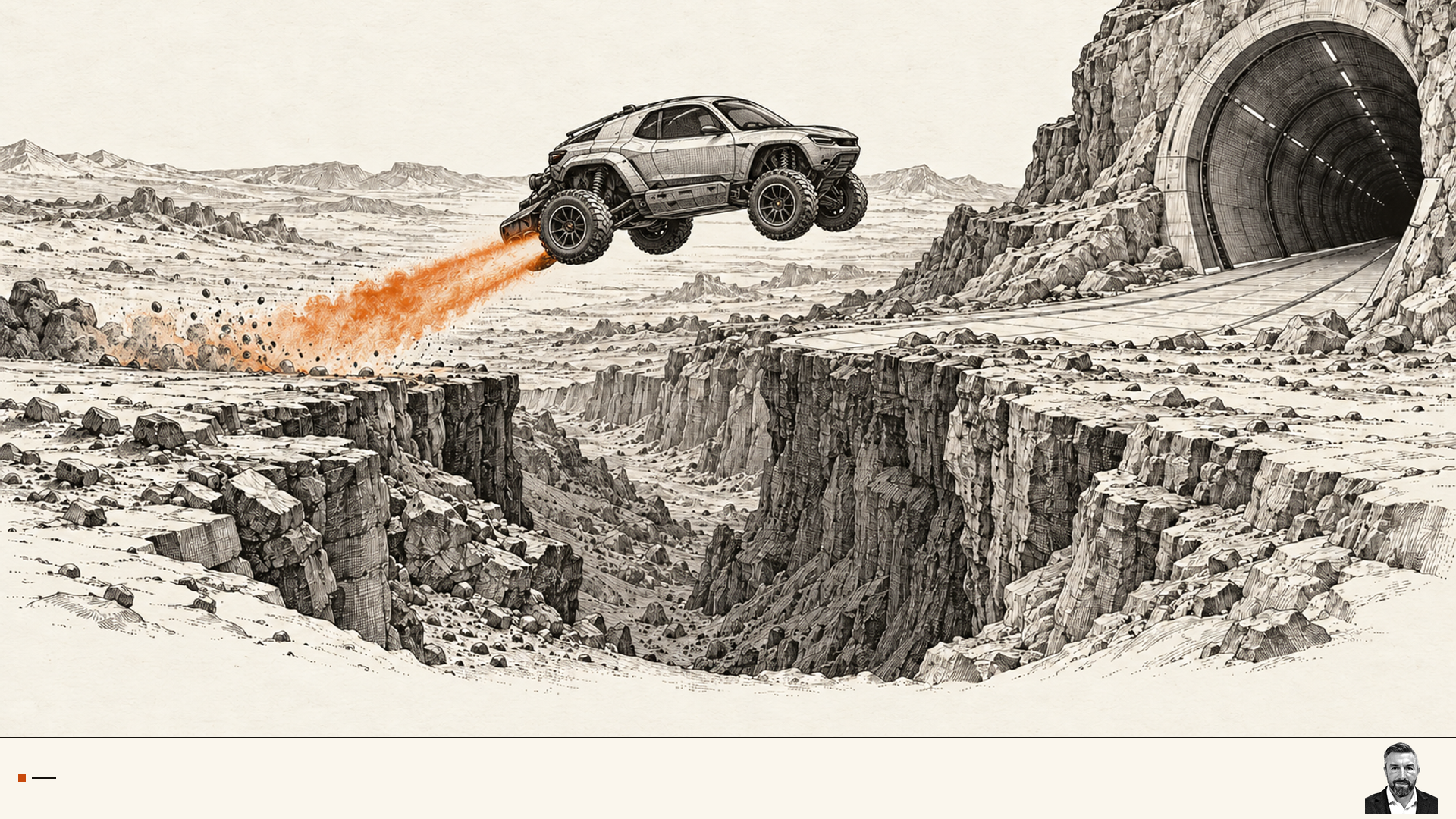
I’m not claiming this is part of Tesla’s announced roadmap. I’m inferring the possibility from watching the reveal and listening to Musk discuss it. Tesla presented a fast, dramatic, low-volume sports car, and the event was designed to make its capabilities look almost impossible. The more interesting accomplishment was the integration beneath the spectacle: a wheeled electric vehicle left the surface supporting it, controlled its position in three dimensions, and returned to that surface without an external recovery system.
On Earth, that makes for a spectacular reveal. On Mars, it may describe a new class of mobility.
The Car Is the Least Interesting Part
Tesla demonstrated several different systems during the event. A suction fan pulled the Roadster toward the surface beneath it and allowed it to climb a curved wall. A stored-gas thruster system produced visible thrust, rotated the car in midair, and helped it land. Rear nozzles accelerated the car hard enough for Tesla to report a 0-to-60 time of 0.81 seconds.
The numbers will dominate the automotive coverage. They are easy to compare, easy to market, and almost beside the point.
Suction fans are old, if cool, news. The Brabham BT46B won its only Formula 1 race in 1978 before the team withdrew it under pressure from rivals. More recently, the McMurtry Spéirling has been shredding racetracks with twin electric fans that generate downforce even while the car is stationary. Applying the idea to something approaching a “regular” road-going vehicle is unusual, but the underlying concept is not new.
The novel part is how the Roadster uses compressed air for vehicle-scale acceleration, attitude control, and controlled landings. The car carries two carbon-wrapped pressure vessels, roughly 600 liters of storage, multiple attitude-control nozzles, and large rear thrusters. Tesla says the system uses compressed air rather than a specialized propellant and can recharge its tanks. SpaceX contributed the propulsion expertise, while Tesla supplied the vehicle, electric architecture, autonomy, and control systems.
The compressed air is only half the achievement. A Roadster is an awkward body to control once its tires leave the surface. It has no wings or conventional flight-control surfaces, and its mass was arranged for driving rather than flying. The software had to monitor the car’s orientation and rotation, coordinate multiple nozzles, stop the maneuver at the correct attitude, and manage the landing.
Tesla has not disclosed which team wrote that control software. Given SpaceX’s involvement and experience controlling rockets through ascent, descent, and landing, SpaceX is the most likely source or contributor. Regardless of authorship, the distinction matters: compressed air provides force; software turns that force into controlled motion.
That combination matters more than the ridiculous quarter-mile time. Tesla and SpaceX have built a vehicle that can transition from tire-based movement to propulsive movement and back again. The system is compact enough to fit inside a two-seat car, precise enough to control the vehicle’s attitude, and integrated deeply enough for the car to land itself.
The Roadster may be the most entertaining Mars technology demonstrator ever built.
Mars Has a Mobility Problem
Mars does not have roads. Early settlements may build smooth routes around a habitat, mine, landing zone, or propellant plant, but exploration will continue beyond them. A rover may encounter rocks, trenches, steep slopes, collapsed lava tubes, soft soil, or terrain that makes the direct route impossible.
Wheels are efficient when the ground cooperates. Mars gives no reason to expect that cooperation.
Researchers have proposed flying and hopping robots for Martian caves and lava tubes for exactly this reason. Wheels struggle with broken terrain and vertical discontinuities. A machine that can briefly leave the surface can cross a trench, descend into a pit, climb out of a depression, or recover after tipping over. It does not need to fly like an aircraft. It needs enough controlled movement to stop treating every break in the terrain as a wall.
That control must also be autonomous. The communication delay between Earth and Mars makes real-time remote piloting impossible. A hopping vehicle must execute the maneuver, correct its own rotation, and recover without waiting for instructions from an operator on Earth. The Roadster demonstrated a version of that closed-loop control alongside the propulsion hardware.
Mars also makes some parts of that problem easier. Surface gravity is about 38 percent of Earth’s. Moving the same mass vertically requires less force, and a short hop carries farther. A propulsion system that produces a small jump on Earth could enable significantly more mobility under Martian gravity.
That does not mean the Roadster system could be bolted onto a Mars rover unchanged. It means Tesla and SpaceX demonstrated the core behavior on the harder gravity setting.
What Survives the Trip to Mars
The cold-gas thrusters provide the strongest connection to Mars. A thruster carries and expels its own working mass, so it does not need dense outside air while firing. A Martian vehicle could use stored gas for short hops, attitude control, self-righting, controlled descents, or emergency recovery.
The recharge mechanism would need to change. Mars has a thin atmosphere made mostly of carbon dioxide. Compressing enough ambient gas would take time and energy, and a practical vehicle might instead draw from a settlement’s locally produced propellant or gas supply. Musk has described Martian infrastructure that would manufacture propellant from local carbon dioxide and water. The Roadster does not solve that infrastructure problem, but its propulsion system begins to show what a vehicle could do once the supply exists.
The suction fan is different. Tesla’s dramatic wall climb depends on creating a pressure difference between the underside of the car and the surrounding atmosphere. Mars offers less than one percent of Earth’s surface pressure. There is very little atmosphere available to create useful suction, so the open-air downforce system has limited value on the Martian surface.
Debris creates a second problem. Rivals complained that the Brabham fan threw dirt and stones at following drivers, although the car’s designer disputed that account. Whether or not the complaint was fair, modern systems confirm that debris management is real: the McMurtry draws its underbody airflow through filters. On open Martian terrain, fine dust and loose rock would burden those filters, threaten skirts and seals, and turn the system into a constant maintenance problem.
That distinction separates the showpiece from the transferable engineering. The fan makes the Earthbound car faster around corners and capable of an unforgettable wall climb. The thrusters demonstrate a movement system that can matter after the pavement ends.
Roadless Vehicles on Earth
Mars is not the only place where that capability could matter. Specialized rescue, mining, firefighting, and disaster-response vehicles routinely operate where roads are damaged, blocked, or absent. A vehicle able to hop a gap, right itself, or make a controlled descent could reach places a conventional wheeled vehicle cannot.
The safety problems are substantial. High-pressure gas produces blast, noise, and debris. The vehicle would need clear operating zones, redundant controls, and rules that ordinary traffic cannot accommodate.
This is not a system you bolt onto an ambulance. The pressure vessels, nozzles, chassis, suspension, center of mass, sensors, and control software would have to be designed together. Think of something closer to a Rivian R1S engineered around thrusters from its first sketch. A flying R1 could bypass a downed bridge, leap a flooded street, cross a washed-out section of road, or right itself after a rollover.
Specialized vehicles operate under different constraints. A mining vehicle in a controlled site, a rescue SUV approaching a collapsed bridge, or an autonomous vehicle crossing disaster debris may justify capabilities that make no sense on a public street. The Roadster demonstrates that the transition between driving and controlled ballistic movement can be managed at vehicle scale.
Three-Dimensional Roads
The suction fan makes little sense on Mars’s thin, dusty surface. Inside a sealed, pressurized, and regularly maintained tunnel, the conditions change. That brings Musk’s Boring Company into the picture. The company has long described transportation as a three-dimensional network of tunnels rather than a single layer of surface roads. On Mars, tunnels could also provide radiation shielding, thermal stability, and protected routes between settlements.
That connection is more than speculation about Musk’s portfolio. In 2016, Musk described Martian settlements with geodesic domes on the surface and tunneling robots creating extensive pressurized space underground for industrial operations. In 2018, SpaceX president Gwynne Shotwell said she believed the Boring Company could also be how people are housed on Mars. If a meaningful portion of a settlement’s infrastructure exists underground, its transportation system will probably be underground as well.
A lined tunnel could provide the clean, controlled surface the fan requires. Lower gravity would reduce the force required to hold a vehicle against a wall or ceiling. That opens the conceptual possibility of placing vehicle paths around more of the tunnel’s circumference instead of treating only the floor as usable space.
Autonomy removes another constraint: the driver no longer has to remain oriented with the chassis. A Tesla robotaxi could place its passenger compartment on a gimbal, keeping the occupants upright while the chassis transitions from the tunnel floor to a wall or ceiling. The entire tunnel surface could become available for vehicle movement. Instead of building a road inside a tube, the tunnel becomes a three-dimensional transport volume.
This is the most speculative part of my hypothesis. Mechanical guides, rails, or magnetic systems may be simpler and safer. The Roadster reveal demonstrated technologies that make three-dimensional vehicle control tangible, while the Boring Company is already pursuing infrastructure designed around three-dimensional transportation. Put those efforts together, and the reveal starts to look less like an isolated car stunt.
A Mars Infrastructure Stack
Elon Musk’s companies are often evaluated independently. SpaceX builds rockets. Tesla builds electric vehicles. The Boring Company digs tunnels. Each company has its own customers, economics, and immediate problems.
Mars gives them a common purpose.
SpaceX would transport people and equipment while providing propulsion expertise. Tesla provides batteries, electric drivetrains, autonomous control, and vehicle manufacturing. The Boring Company contributes excavation and underground transportation. A Mars settlement will need every one of those capabilities, and it will need them to work as a system.
Optimus belongs in that system as well. Tesla placed one of its humanoid robots behind the wheel during the flying demonstrations, although the Roadster itself was operating autonomously. Tesla is also converting the Fremont production space formerly used for the Model S and Model X to build Optimus robots. The Roadster completes the connection by using by-wire control for steering, braking, and throttle, which gives software direct control over every primary driving input.
The demonstration was delicious theater, but it also placed Tesla’s vehicle, robotics, manufacturing, and autonomous-control programs in the same frame. On Mars, where human labor will be scarce and outside work will be dangerous, machines that can operate independently will be essential infrastructure.
The Roadster reveal was staged at SpaceX’s McGregor test site and opened with a Raptor engine firing. Musk repeatedly described the car as a Tesla and SpaceX collaboration. The location and presentation made the connection explicit, even if the event never offered the Mars interpretation I am making here.
That interpretation fits Musk’s larger pattern. Technologies developed for profitable or compelling Earth markets can also mature capabilities required for Mars. Reusable rockets build launch capability through satellite missions before any attempt to carry settlers. Electric vehicles create battery, motor, power-electronics, and autonomy expertise. Tunneling serves congested cities before it serves an off-world settlement. A spectacular sports car gives Tesla and SpaceX a reason to package propulsion, autonomy, and vehicle control into one platform.
Circumstantial Evidence
This is a hypothesis built from circumstantial evidence, not an announced roadmap. Every component has an immediate Earthbound purpose, and none requires a secret Mars plan to make sense. Tesla has not announced a Mars rover. The Roadster could remain nothing more than an extravagant way to make a sports car accelerate and perform stunts.
Questions about production readiness, road legality, repeatability, final range, price, and reliability still matter to anyone considering the car itself. They do not erase what the prototype demonstrated.
No matter what happens to the Roadster, the engineering is real. The prototype packages gas storage, thrust control, autonomous attitude management, and conventional driving into one vehicle. Its engineers have begun learning how the tanks, valves, control software, and recovery behavior perform under real development pressure instead of leaving the entire idea on a slide in a Mars architecture presentation.
That is how enabling technologies often arrive. They are funded for one purpose, refined through another, and remembered for the problem they eventually make solvable.
The Roadster will probably be sold as a spectacular car. Its more important legacy may come from showing that a vehicle can leave the road, control itself in three dimensions, and return safely.
On Mars, that may matter far more than its quarter-mile time.
Receipts
- Tesla Roadster reveal: Tesla’s full event video shows the wall climb, midair rotation, landing, Optimus passenger, active aerodynamics, and rear-thruster acceleration.
- Event transcript: The Elon Musk Archive transcript records the stated pressure-vessel capacity, nozzle arrangement, compressed-air system, by-wire controls, acceleration result, production target, and Tesla-SpaceX collaboration.
- Optimus manufacturing: The Associated Press reported Tesla’s conversion of Fremont production capacity from Model S and Model X manufacturing to Optimus production.
- Independent event reporting: Reuters and TechCrunch reported the prototype demonstrations, SpaceX-derived thrusters, and announced 2028 production target.
- Fan-car precedent and debris management: Formula 1’s history of the Brabham BT46B documents the earlier use of fan-generated downforce. Motorsport’s history of the car records rival complaints about dirt and stones, while McMurtry’s production Spéirling announcement confirms that its modern system draws underbody air through filters.
- Evidence boundary: PostCutoff’s frame analysis distinguishes what the demonstration footage shows from what it cannot establish about production readiness, repeatability, legality, or final specifications.
- Mars environment: NASA’s Mars fact sheet lists surface gravity at 3.73 m/s2 and mean surface pressure at roughly 6.36 millibars.
- Thin-atmosphere flight: NASA’s Ingenuity press kit explains the low atmospheric density, reduced gravity, autonomy requirements, and engineering challenges of controlled flight on Mars.
- Hopping-robot research: Research on flying and hopping pit-bots and jumping robots for Martian lava tubes describes the limitations of wheels in steep, broken, and collapsed terrain.
- Mars tunnels and propellant: In a 2020 Mars Society discussion, Musk discussed producing propellant from Martian carbon dioxide and water, the usefulness of tunneling, and the need to reduce excavation-system mass for Mars.
- Underground infrastructure: Musk’s 2016 description of a Mars settlement placed green living space in surface domes and industrial operations in extensive pressurized tunnels below them.
- Underground housing: In 2018, SpaceX president Gwynne Shotwell said the Boring Company could provide housing on Mars.
- Three-dimensional tunnel strategy: TechCrunch’s coverage of the Boring Company demonstration documents Musk’s description of stacked tunnels as a three-dimensional transportation network.